
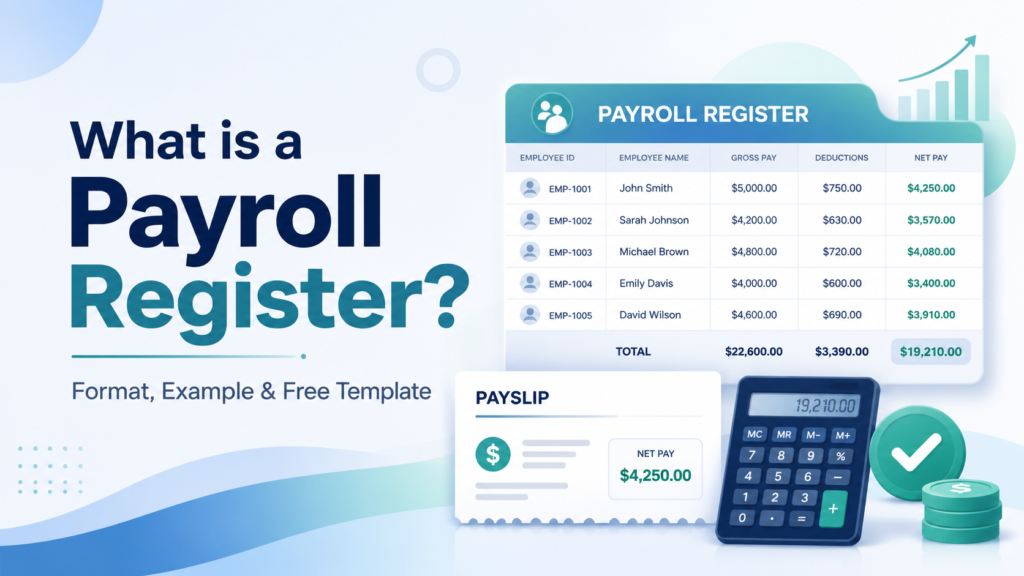
What is a Payroll Register? Format, Example & Free Template Guide
What is a Payroll Register?
Every month, a business pays its employees. But paying salaries is not as simple as handing over cash. A company needs to track how much each employee earned, how much tax was deducted, what the employer contributed toward benefits, and what the final take-home pay was all in one organised document.
That document is called a payroll register.
A payroll register is a detailed accounting record that summarises all payroll information for every employee for a specific pay period. It shows gross earnings, all deductions, employer contributions, and the net pay for each employee in a single, structured format.
Think of it as the master spreadsheet of your company’s payroll. Before any salary is paid, every number goes into the payroll register. After salaries are paid, the payroll register becomes the proof that everything was calculated correctly and paid in full. You can calculate your salary by our dedicated Salary Calculator as well.
A quick analogy: if payroll were a restaurant kitchen, the payroll register would be the chef’s master recipe list showing exactly what went into every dish, in what quantity, and what came out at the end. Without it, the kitchen is chaos.
Table of Contents
Why Does a Payroll Register Matter?
The payroll register serves several important purposes at the same time:
For the accounting team, it is the source document for posting payroll journal entries into the general ledger. Without a completed payroll register, you cannot accurately record salaries expense.
For management, it provides a full breakdown of the company’s total labour cost not just the salaries paid to employees, but also the employer’s contributions to provident funds, health insurance, and other benefits.
For auditors, it is key evidence during a financial audit. Auditors compare the payroll register against bank payment records, individual payslips, and tax filings to confirm that payroll was processed accurately and that no ghost employees exist.
For employees, a payroll register forms the basis of their individual payslips. Every number on a payslip comes directly from the payroll register.
For tax authorities, the payroll register supports the company’s withholding tax returns and social security filings. If a company is inspected, the payroll register is one of the first documents requested.
In short: the payroll register is the heartbeat of payroll accounting. Everything flows from it, and everything is verified against it.
Payroll Register vs Payroll Journal: What is the Difference?
Before we go deeper, let us clear up a common confusion.
A payroll register is a detailed operational record. It lists every employee, every earning, every deduction, and every net pay for the period. It is used by the payroll team to process payments.
A payroll journal entry is an accounting entry posted in the general ledger, summarising the totals from the payroll register. It moves the payroll figures from the payroll register into the books of account.
| Feature | Payroll Register | Payroll Journal Entry |
|---|---|---|
| Purpose | Record individual payroll data | Record payroll in general ledger |
| Level of detail | Every employee listed separately | Totals only (no individual names) |
| Used by | Payroll team, HR, managers | Accounting team |
| Document type | Operational report | Accounting entry |
| Comes first? | Yes — register is prepared first | Prepared using register totals |
The payroll register is the raw material. The payroll journal entry is what you build from it.
What Are the Components of a Payroll Register?
A standard payroll register has several clearly defined sections. Understanding each component helps you build one accurately and read one intelligently.
Section 1: Employee Identification
This section identifies who is being paid.
- Employee ID — a unique code assigned to each employee (e.g., EMP-001, EMP-002)
- Employee Name — full legal name
- Department — which department the employee belongs to (Sales, Finance, Operations, etc.)
- Job Title or Grade — helps confirm the correct pay rate is being applied
- Pay Period — the specific dates covered (e.g., 1 June 2024 to 30 June 2024)
Section 2: Gross Earnings
Gross earnings is the total amount earned by the employee before any deductions.
- Regular Hours Worked — number of standard hours worked in the period
- Regular Pay Rate — the hourly rate or agreed monthly salary
- Regular Pay — regular hours × regular rate (for hourly workers) or the fixed monthly salary
- Overtime Hours — any hours worked beyond the standard working week
- Overtime Rate — usually 1.5× or 2× the regular hourly rate, depending on the employment contract or labour law
- Overtime Pay — overtime hours × overtime rate
- Other Allowances — house rent allowance, transport allowance, medical allowance, performance bonus
- Total Gross Pay — sum of all earnings above
Section 3: Deductions
Deductions are amounts subtracted from gross pay before the employee receives anything.
Employee-side deductions:
- Income Tax / PAYE (Pay As You Earn) — tax withheld from salary based on applicable tax slab
- Provident Fund / Pension Contribution (Employee Share) — employee’s own contribution toward retirement savings
- Health Insurance Premium (Employee Share) — if health insurance is partly funded by the employee
- Loan Repayment / Advance Recovery — repayment of salary advances or staff loans
- Absence Deduction — deduction for unpaid leave or unauthorised absence
- Total Deductions — sum of all deductions above
Section 4: Net Pay
Net Pay = Total Gross Pay − Total Deductions
This is the actual amount the employee receives — their take-home pay. It is the amount transferred to the employee’s bank account or paid in cash.
Section 5: Employer Contributions
These are costs borne by the employer on top of the employee’s gross salary. They do not reduce the employee’s net pay, but they increase the total cost of employment to the company.
- Employer’s Provident Fund Contribution — employer’s share of the provident/pension fund
- Employer’s Social Security Contribution — contribution to a national social security or insurance scheme
- Employer’s Health Insurance Contribution — employer’s share of health insurance premiums
- Total Employer Contributions — sum of employer’s additional costs
Section 6: Cost to Company (CTC)
Total Cost to Company = Gross Pay + Total Employer Contributions
This is the true cost of employing a person. It is always higher than what the employee sees on their payslip.
Payroll Register Format: Full Example
Let us look at a sample payroll register for a small company, FastBridge Ltd, for the month of June 2024. The company has five employees.
Note on tax rates used in this example: Income tax deductions are illustrative. Always apply the tax slabs applicable in your country (e.g., Bangladesh Income Tax for local readers, or PAYE for UK/international context).
FastBridge Ltd — Payroll Register — June 2024
Pay Period: 1 June 2024 to 30 June 2024
EMPLOYEE EARNINGS
| Emp ID | Name | Department | Basic Salary | HRA | Transport Allow. | Overtime Pay | Gross Pay |
|---|---|---|---|---|---|---|---|
| EMP-001 | Karim, A. | Finance | 50,000 | 10,000 | 3,000 | 0 | 63,000 |
| EMP-002 | Rahman, S. | Sales | 40,000 | 8,000 | 3,000 | 4,500 | 55,500 |
| EMP-003 | Begum, R. | Operations | 35,000 | 7,000 | 2,500 | 2,000 | 46,500 |
| EMP-004 | Islam, T. | IT | 55,000 | 11,000 | 3,000 | 0 | 69,000 |
| EMP-005 | Ahmed, N. | HR | 30,000 | 6,000 | 2,500 | 0 | 38,500 |
| TOTAL | 210,000 | 42,000 | 14,000 | 6,500 | 272,500 |
DEDUCTIONS
| Emp ID | Name | Income Tax | Provident Fund (Employee) | Advance Recovery | Total Deductions |
|---|---|---|---|---|---|
| EMP-001 | Karim, A. | 3,150 | 5,000 | 0 | 8,150 |
| EMP-002 | Rahman, S. | 2,775 | 4,000 | 2,000 | 8,775 |
| EMP-003 | Begum, R. | 2,325 | 3,500 | 0 | 5,825 |
| EMP-004 | Islam, T. | 3,450 | 5,500 | 0 | 8,950 |
| EMP-005 | Ahmed, N. | 1,925 | 3,000 | 1,000 | 5,925 |
| TOTAL | 13,625 | 21,000 | 3,000 | 37,625 |
NET PAY & EMPLOYER CONTRIBUTIONS
| Emp ID | Name | Gross Pay | Total Deductions | Net Pay | Employer PF | Total Cost to Company |
|---|---|---|---|---|---|---|
| EMP-001 | Karim, A. | 63,000 | 8,150 | 54,850 | 5,000 | 68,000 |
| EMP-002 | Rahman, S. | 55,500 | 8,775 | 46,725 | 4,000 | 59,500 |
| EMP-003 | Begum, R. | 46,500 | 5,825 | 40,675 | 3,500 | 50,000 |
| EMP-004 | Islam, T. | 69,000 | 8,950 | 60,050 | 5,500 | 74,500 |
| EMP-005 | Ahmed, N. | 38,500 | 5,925 | 32,575 | 3,000 | 41,500 |
| TOTAL | 272,500 | 37,625 | 234,875 | 21,000 | 293,500 |
Register Summary:
- Total Gross Pay: 272,500
- Total Employee Deductions: (37,625)
- Total Net Pay to Employees: 234,875
- Total Employer PF Contributions: 21,000
- Total Payroll Cost to Company: 293,500
Prepared by: _________________ Date: ____________
Reviewed by: _________________ Date: ____________
Approved by: _________________ Date: ____________
That is a complete payroll register. Notice how every number is traceable. The total gross pay (272,500) will appear in the salary expense account. The total income tax withheld (13,625) will appear as a tax liability. The net pay (234,875) will match the bank payment to employees. Everything ties together.
How to Prepare a Payroll Register: Step-by-Step
Follow these steps each pay period to prepare an accurate payroll register.
Step 1: Gather Attendance and Time Records
Before calculating any pay, collect data on who worked, for how many hours, and whether there was any overtime, leave, or absence.
Sources include: attendance registers, biometric records, time sheets, leave applications, and HR records of absent days.
Example: Rahman, S. (EMP-002) worked 22 standard days in June and an additional 15 overtime hours. His standard monthly salary is BDT 40,000, and his overtime rate is BDT 300 per hour.
Overtime pay = 15 hours × 300 = BDT 4,500.
Step 2: Calculate Gross Earnings
For each employee, calculate:
Regular pay + all allowances + overtime pay + any bonuses = Total Gross Pay
For salaried employees without overtime, gross pay is simply the agreed monthly salary plus fixed allowances.
For hourly employees:
Gross Pay = (Regular hours × Regular rate) + (Overtime hours × Overtime rate) + Allowances
Example: For EMP-002 Rahman:
- Basic: 40,000
- HRA: 8,000
- Transport: 3,000
- Overtime: 4,500
- Gross: 55,500
Step 3: Calculate Deductions
Calculate each deduction separately and then total them.
Income Tax: Apply the correct income tax rates based on your country’s tax law. In Bangladesh, use the current income tax slabs published by the National Board of Revenue (NBR). For illustrative purposes in our example above, we have applied a simplified flat rate — in practice, use the actual graduated slabs applicable to each employee’s annual income.
Provident Fund (Employee’s Share): Many employment contracts specify a fixed percentage (commonly 10% of basic salary). Employee PF for EMP-001: 10% × 50,000 basic = 5,000.
Advance Recovery: If any employee has taken a salary advance, the agreed instalment is deducted this month.
Total Deductions = Income Tax + Employee PF + Advance Recovery + any other deductions
Step 4: Calculate Net Pay
This is straightforward:
Net Pay = Gross Pay − Total Deductions
Double-check each employee’s net pay. It should be positive. A negative net pay is impossible in practice and signals a data entry error.
Step 5: Calculate Employer Contributions
These are separate from employee deductions. The employer contributes its own share toward PF, social security, and any other benefit schemes.
Example: In our register, FastBridge Ltd contributes an amount equal to the employee’s own PF contribution (10% of basic) for each employee.
Employer PF for EMP-001 = 10% × 50,000 = 5,000
Step 6: Calculate Total Cost to Company
Total Cost to Company = Gross Pay + Employer Contributions
This is the true labour cost the company incurs for each employee.
Step 7: Prepare the Register Summary
Add up all columns:
- Total gross pay across all employees
- Total deductions across all employees
- Total net pay
- Total employer contributions
- Grand total cost to company
Cross-check: Total Gross Pay − Total Deductions = Total Net Pay. This must balance exactly.
Step 8: Get Approvals
A payroll register should never be acted upon without a review and approval process. Typically:
- Prepared by the payroll officer (data entry and initial calculation)
- Reviewed by the Finance Manager (checks accuracy of all figures)
- Approved by the Managing Director or CFO (final authorisation for payment)
This three-stage approval is itself an application control — an authorisation check that prevents unauthorised payments. (Refer to our previous article on Application Controls for more on this.)
Step 9: Process Payments
Once approved, the payroll register drives the actual bank payments or cash disbursements. Each employee’s net pay is transferred based on their recorded bank account details.
Step 10: Post the Payroll Journal Entry
After payments are made, the accounting team posts the payroll figures from the register into the general ledger.
Payroll Journal Entry: Recording Payroll in the Books
The payroll register gives you all the numbers you need to make the journal entry. Using the totals from our FastBridge Ltd example:
Entry 1: Recording Payroll Expense (on salary payment date)
Dr. Salaries & Wages Expense 272,500
Dr. Employer Provident Fund Expense 21,000
Cr. Income Tax Payable 13,625
Cr. Employee Provident Fund Payable 21,000
Cr. Employer Provident Fund Payable 21,000
Cr. Salary Advance Recovered (liability) 3,000
Cr. Bank / Cash (net salaries paid) 234,875
Let us verify this balances:
- Debits: 272,500 + 21,000 = 293,500
- Credits: 13,625 + 21,000 + 21,000 + 3,000 + 234,875 = 293,500 ✓
The entry balances. Every number in this journal entry can be traced directly back to a column total in the payroll register. That traceability is what makes the payroll register so important for accounting accuracy.
Entry 2: Remitting Deductions to Authorities (when tax and PF are paid)
Dr. Income Tax Payable 13,625
Dr. Employee Provident Fund Payable 21,000
Dr. Employer Provident Fund Payable 21,000
Cr. Bank 55,625
This second entry records the payment of withheld amounts to the tax authority and the provident fund administrator.
What is the Difference Between a Payroll Register and a Paycheck?
A paycheck (or payslip) is the individual document given to each employee showing their own earnings and deductions for the period.
A payroll register is the company’s comprehensive internal record covering all employees together.
| Feature | Payroll Register | Paycheck / Payslip |
|---|---|---|
| Covers | All employees | One employee only |
| Used by | Accounting, management, auditors | Individual employee |
| Confidentiality | Strictly internal — confidential | Given to the individual employee |
| Purpose | Accounting record, control tool | Employee’s personal earnings record |
| Contains employer contributions? | Yes | Usually not (employee-facing only) |
When an auditor asks for payroll records, they want the payroll register not individual payslips.
When an employee queries their salary, they refer to their payslip not the full register.
What is Labour Burden and Why Does It Appear in Payroll?
When you look at the total cost to company column in the payroll register, you will see it is always higher than gross pay. The difference is what is called the labour burden (also called on-costs or employment overhead).
Labour burden = Total Cost to Company − Gross Pay
In our example: 293,500 − 272,500 = BDT 21,000 in labour burden (employer PF contributions alone).
In practice, labour burden includes:
- Employer’s provident fund / pension contributions
- Employer’s social security / national insurance contributions
- Employer-paid health or life insurance
- Workers’ compensation insurance
- Paid holiday and leave provisions
- Training levies (where applicable)
The labour burden rate expresses this as a percentage of gross pay:
Labour Burden Rate = (Total Employer Contributions / Total Gross Pay) × 100
In our example: (21,000 / 272,500) × 100 = 7.7%
This means for every BDT 100 of salary FastBridge Ltd pays, the actual cost is BDT 107.70.
Understanding labour burden is essential for job costing, project budgeting, and pricing decisions. If you are a contractor or a service firm and you bid a project based on salary alone without factoring in labour burden, you will underprice your services every single time.
Common Mistakes in Preparing a Payroll Register
Payroll Register in the Context of Bangladesh Labour Law
For readers in Bangladesh, the payroll register must be consistent with the requirements of the Bangladesh Labour Act 2006 (as amended) and the Bangladesh Income Tax Act 2023.
Key points:
Minimum Wage: The payroll register must reflect the minimum wage for each category of worker as set by the Minimum Wage Board. For the garments sector, these rates are updated periodically.
Overtime Calculation: Under the Labour Act, overtime pay must be at least twice the regular rate (Section 108). The payroll register must show overtime hours and the rate applied.
Festival Bonus: Employees are generally entitled to two festival bonuses per year, each equivalent to one month’s basic salary. These should appear as separate line items in the payroll register in the relevant months.
Income Tax Withholding: The Finance Act sets the income tax slabs applicable to employment income each year. The payroll officer must apply the current year’s rates, which are available from the National Board of Revenue (NBR) at nbr.gov.bd.
Provident Fund: Where a recognised provident fund exists, both employee and employer contributions must be recorded in the payroll register and remitted to the fund within the specified time.
Maintaining a complete and accurate payroll register is not just good accounting practice under the Labour Act, employers are required to maintain proper wages records and make them available for inspection by labour inspectors.
Payroll Register Template: What to Include
If you are building your own payroll register (in Excel or Google Sheets), include at minimum the following columns:
Header section:
- Company name
- Pay period (from date — to date)
- Pay date
- Prepared by / Reviewed by / Approved by fields
Per employee rows:
- Employee ID
- Employee Name
- Department
- Basic Salary
- Allowances (HRA, Transport, Medical — separate columns)
- Overtime Hours and Overtime Pay
- Total Gross Pay
- Income Tax Deducted
- Employee Provident Fund
- Other Deductions (loan recovery, absence, etc.)
- Total Deductions
- Net Pay
- Employer PF Contribution
- Total Cost to Company
- Payment Method (bank transfer / cash)
- Bank Account Number (for bank transfer verification)
- Remarks
Footer totals row:
- Column totals for every numeric column
Reconciliation check (below the table):
- Total Gross Pay: _______
- Less: Total Deductions: (_______)
- = Total Net Pay: _______
- Plus: Total Employer Contributions: _______
- = Total Cost to Company: _______
This reconciliation box forces you to verify the register before signing off. If the numbers do not tie together, you will catch it here before any money is paid.
How Auditors Use the Payroll Register
During an audit, the payroll register is central to testing completeness, accuracy, and validity of payroll expenses which is often one of the largest expense items on an income statement.
Auditors will typically:
Test existence of employees (ghost employee check): Select a sample of employees from the payroll register and confirm they actually exist by checking their employee files, contracts, HR records, or in some cases physical confirmation. A ghost employee is a fictitious name on the payroll to which someone is fraudulently diverting salary payments.
Recalculate gross pay: Take a sample of employees and independently recalculate gross pay using attendance records and agreed pay rates. Compare to the payroll register.
Verify deductions: Re-apply the applicable income tax slabs and provident fund rates to a sample of employees and confirm the deductions on the register are correct.
Reconcile to bank payments: Agree the total net pay on the register to the bank payment instruction and the bank statement. All three figures must match.
Check authorisation: Confirm the payroll register bears the required approval signatures before payment was released.
Compare year-on-year: Compare total payroll this year to last year. Significant unexplained increases in headcount, average salary, or total payroll cost are potential red flags.
The audit procedures above are grounded in ISA 500: Audit Evidence and ISA 330: The Auditor’s Responses to Assessed Risks, which require auditors to obtain sufficient appropriate evidence to support their opinion.
Summary
- A payroll register is a detailed record of all payroll data — earnings, deductions, employer contributions, and net pay for all employees for a given pay period.
- It has three main sections: gross earnings, deductions, and net pay. Employer contributions are tracked separately as part of the total cost to company.
- Preparing a payroll register follows a clear sequence: gather attendance data → calculate gross pay → calculate deductions → compute net pay → add employer contributions → summarise and reconcile → get approvals → process payments → post the journal entry.
- The payroll journal entry is derived directly from the register totals. Every debit and credit traces back to a column in the register.
- Labour burden employer contributions on top of gross salary represents the true cost of employment and is essential for job costing and pricing decisions.
- Auditors rely on the payroll register to test completeness, accuracy, and validity of salary expenses, and to detect ghost employees and other payroll fraud.
- In Bangladesh, the payroll register must comply with the Labour Act 2006 and the current income tax rules set by NBR.
Frequently Asked Questions (FAQs)
A payroll register should be prepared for every pay run — monthly, bi-weekly, or weekly depending on the company's pay cycle. Most companies in Bangladesh operate a monthly payroll, so a new register is prepared once per month.
Not exactly. A payroll register shows the detail for every individual employee. A payroll summary just shows the totals total salaries, total tax, total net pay. The summary is derived from the register. For accounting and audit purposes, the full register is needed.
Yes, the working register used internally to process bank payments should include each employee's bank account number so payments go to the right account. However, when sharing the register with auditors or for internal review, some companies redact bank account numbers for data privacy.
This varies by jurisdiction. In Bangladesh, accounting records are generally required to be retained for at least 5 years. Under the Income Tax Act, payroll records supporting tax filings should be available for inspection during the assessment period. Many companies keep payroll records for 7 years as a conservative practice.
Microsoft Excel or Google Sheets works for small businesses. Dedicated payroll software like Tally Prime, QuickBooks Payroll, or HR-specific systems generate the register automatically once you set up employee data and pay structures. Large companies use ERP systems like SAP HCM or Oracle HRMS, which generate fully automated payroll registers with built-in controls.
A timesheet records what an employee actually worked hours in, hours out, total regular and overtime hours, for each day of the pay period. The payroll register uses timesheet data to calculate pay. The timesheet is the input; the payroll register is the output. We cover timesheets in detail in our related article: What is a Timesheet? Types, Purpose & Format.
References
- Bangladesh Labour Act 2006 (Act No. XLII of 2006), as amended. Sections on wages, overtime, and record-keeping. Available at: bdlaws.minlaw.gov.bd
- National Board of Revenue, Bangladesh. Income Tax Act 2023 and current tax slabs for employment income. Available at: nbr.gov.bd
- International Auditing and Assurance Standards Board (IAASB). ISA 500: Audit Evidence. Available at: iaasb.org
- International Auditing and Assurance Standards Board (IAASB). ISA 330: The Auditor’s Responses to Assessed Risks. Available at: iaasb.org
- International Federation of Accountants (IFAC). Guide to Quality Management for SMPs. Section on payroll controls.
- Weygandt, J.J., Kimmel, P.D. and Kieso, D.E. Accounting Principles. 14th edition. Wiley, 2022. (Chapter on payroll accounting and internal controls)
- Needles, B.E. and Powers, M. Principles of Financial Accounting. Cengage Learning, 2020. (Payroll register preparation and journal entries)
- Ministry of Finance, Bangladesh. Finance Act (current year) — applicable income tax rates. Available at: mof.gov.bd
Disclaimer: Content is for educational purposes. For specific payroll compliance advice for your jurisdiction, consult a qualified tax professional.

I’m amazed, I have to admit. Seldom do I encounter a
blog that’s both equally educative and interesting, and let me tell you, you’ve hit the nail on the head.
The problem is something too few people are speaking intelligently about.
Now i’m very happy I found this during my hunt for something relating
to this.
I am glad that it helped you. Stay tuned.