
Notes Payable: Definition, Journal Entries & the "0% Interest" Trap
The “Interest-Free” Loan That Isn’t
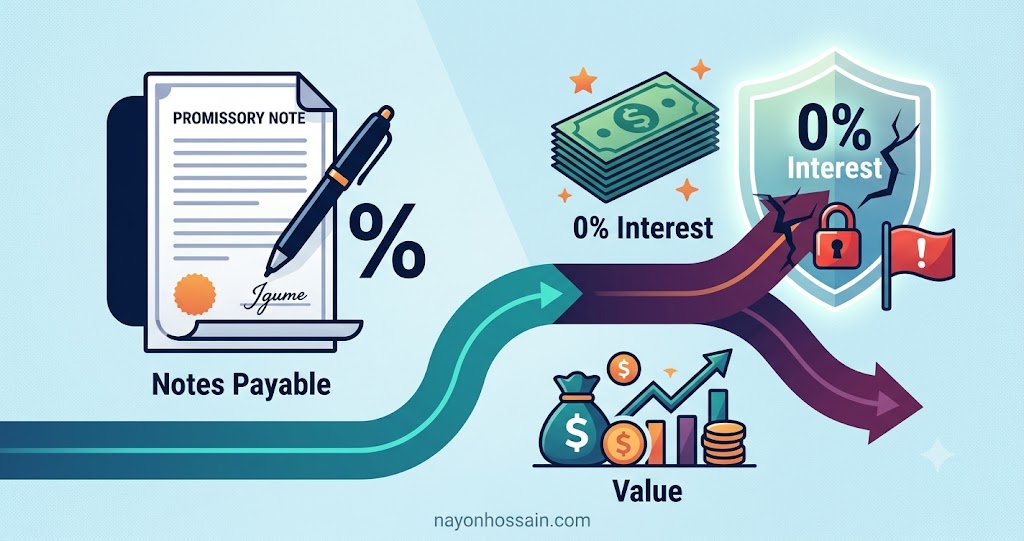
Here’s a deal that sounds too good to pass up: a supplier offers to sell your company a piece of equipment for $100,000 but instead of paying now, you sign a note agreeing to pay the full $100,000 in two years’ time, with zero interest.
No interest charges. No monthly payments. Just $100,000, due in 24 months. It feels like free money.
Under accounting standards, it isn’t. And if your company recorded this transaction at face value $100,000 of equipment, $100,000 of notes payable your financial statements would be wrong, potentially by tens of thousands of dollars, in a way that an auditor (applying exactly the valuation assertion from our audit assertions article) would flag immediately.
By the end of this article, you’ll understand exactly why “0% interest” is often an accounting fiction and how to record it correctly. But first, the fundamentals.
What is a Note Payable?
A note payable is a liability representing a formal, written promise to pay a specific sum of money to another party, on a specified date or dates, usually with interest.
The document underlying a note payable is called a promissory note, a legally recognised instrument. In Bangladesh, India, and other jurisdictions inheriting British-era commercial law, promissory notes are formally governed by the Negotiable Instruments Act, 1881, which defines a promissory note as a written, signed, unconditional undertaking to pay a certain sum of money to a specified person (or to the bearer).
That word “unconditional” matters. A note payable isn’t a vague intention to pay “when convenient” it’s a specific, enforceable commitment: a fixed amount, a fixed date (or dates), and (usually) a stated interest rate.

How to Price Items for Resale: The Accountant's Method
Notes Payable vs Accounts Payable: Why the Distinction Matters
If you’ve read our earlier articles on return inward/outward and discount allowed/received, you’ve already encountered accounts payable amounts owed to suppliers for goods or services purchased on credit. Notes payable might sound similar, but the two are structurally different in ways that genuinely matter.
| Feature | Accounts Payable | Notes Payable |
|---|---|---|
| Formal written agreement? | No — informal trade credit arrangement | Yes — a signed promissory note |
| Interest? | Typically none stated (though early-payment discounts, covered in our discount allowed/received article, function as implicit interest) | Usually an explicit, stated interest rate |
| Typical source | Suppliers, in the normal course of trade | Banks, formal lenders, or suppliers for large/unusual purchases |
| Typical term | Short — often 30, 60, or 90 days | Can be short-term or extend over several years |
| Transferable? | Generally not | Often yes — a promissory note is a negotiable instrument that can, in principle, be endorsed and transferred to a third party |
| Triggered by | Routine purchases of inventory or services | Borrowing cash, financing a large asset purchase, or converting an overdue account payable into a formal obligation |
A practical scenario that bridges the two: a customer owes a supplier $50,000 on ordinary trade terms (accounts payable) but is struggling to pay on time. Rather than write off the debt or pursue costly legal action, the supplier might agree to convert that informal $50,000 account payable into a formal note payable with a stated interest rate and a specific repayment schedule. The underlying debt hasn’t changed; its legal form has and as we know from the substance-over-form discussion in our accounting concepts article, accounting must reflect this change in substance.
Basic Journal Entries: An Interest-Bearing Note
Let’s start with the straightforward case, a note that explicitly states an interest rate, with interest accruing over time.
Scenario: On 1 October 2024, a company borrows $50,000 from a bank, signing a 6-month promissory note at 9% annual interest. Both principal and accrued interest are due in full at maturity on 31 March 2025. The company’s year-end is 31 December.
Entry 1: Issuing the Note (1 October 2024)
Dr. Cash                     50,000
    Cr. Notes Payable               50,000
The company receives $50,000 cash and recognises a $50,000 liability straightforward so far.
Entry 2: Year-End Adjusting Entry (31 December 2024)
This is where the accrual concept from our accounting concepts article does its work. Even though no interest has been paid, three months of interest have been incurred — and must be recognised in 2024’s financial statements, not deferred until the cash payment in 2025.
Interest for 3 months = $50,000 × 9% × (3/12) = $1,125
Dr. Interest Expense          1,125
    Cr. Interest Payable             1,125
Entry 3: Repayment at Maturity (31 March 2025)
By maturity, a further 3 months of interest (January–March) has accrued: $50,000 × 9% × (3/12) = $1,125.
Dr. Notes Payable             50,000
Dr. Interest Payable           1,125    (the amount already accrued in 2024)
Dr. Interest Expense           1,125    (the additional 3 months, incurred in 2025)
    Cr. Cash                                52,250
Total interest over the 6-month life of the note = $1,125 + $1,125 = $2,250 — which matches $50,000 × 9% × (6/12) ✓. Notice how the total interest cost is split across two accounting periods (2024 and 2025) according to when it was actually incurred exactly the matching principle in action, and exactly the kind of cutoff issue we explored from an audit perspective in our audit assertions article.
Where Notes Payable Sit on the Balance Sheet
A note payable is classified as either a current liability or a non-current liability, based on the same 12-month rule established in our Statement of Financial Position article: if the note is due for repayment within 12 months of the balance sheet date, it’s current; otherwise, it’s non-current.
A particularly important and frequently mis-handled situation arises with long-term notes payable that include a current portion. Suppose a company has a 5-year note payable with $20,000 of principal due within the next 12 months, and $80,000 due thereafter.
NON-CURRENT LIABILITIES
  Notes Payable (long-term portion)           80,000

CURRENT LIABILITIES
  Current portion of long-term notes payable   20,000
This is precisely Mistake 1 flagged in our Statement of Financial Position article: failing to reclassify the current portion of a long-term liability distorts the current ratio and working capital, two of the key liquidity metrics covered in that article. A note payable doesn’t sit statically in one category for its entire life; its presentation shifts year by year as the remaining term shortens.
The Main Event: Non-Interest-Bearing Notes and Imputed Interest
Now let’s return to the scenario this article opened with and work through it properly.
Why “0% Interest” Can’t Be Taken at Face Value
Under IFRS 9, Financial Instruments, a financial liability including a note payable must initially be recognised at its fair value. For a note that bears a stated interest rate roughly equal to the market rate for similar borrowing, fair value and face value are approximately the same, and no adjustment is needed (as in our 9% bank loan example above).
But when a note states 0% interest or any rate significantly below the market rate a lender would normally charge for a borrower’s credit risk the face value of the note overstates its fair value. Why? Because $100,000 received two years from now is worth less than $100,000 today a direct application of the time value of money. A truly “interest-free” $100,000 note due in two years is not economically equivalent to $100,000 cash today; it’s equivalent to some smaller amount today, plus an implicit interest cost embedded in the gap between that smaller amount and the $100,000 face value.
This implicit cost has a name: imputed interest (sometimes called a discount on the note).
Working Through the Example
Facts: A company acquires equipment by signing a non-interest-bearing note payable with a face value of $100,000, due in 2 years. The market rate of interest for a loan of this risk profile is 8% per annum.
Step 1 — Calculate the present value of the note, discounting the $100,000 face value back two years at the market rate:
PV = $100,000 ÷ (1.08)² = $100,000 ÷ 1.1664 = $85,734 (rounded)
Step 2 — Record the initial transaction at this present value — not at face value:
Dr. Equipment                 85,734
Dr. Discount on Notes Payable 14,266
    Cr. Notes Payable               100,000
The $14,266 “discount” represents the imputed interest that will be recognised as an expense over the life of the note. Some presentations show Notes Payable net of this discount directly (at $85,734), with the discount disclosed in the notes; either presentation results in the same carrying amount of $85,734.
Step 3 — Recognise interest expense each year using the effective interest method, applying the 8% market rate to the carrying amount of the liability (not its face value):
| Year | Carrying amount (start) | Interest expense (8%) | Carrying amount (end) |
|---|---|---|---|
| 1 | $85,734 | $6,859 | $92,593 |
| 2 | $92,593 | $7,407 | $100,000 |
Year 1:
Dr. Interest Expense           6,859
    Cr. Notes Payable (or Discount account)   6,859

Year 2:
Dr. Interest Expense           7,407
    Cr. Notes Payable (or Discount account)   7,407
By the end of Year 2, the carrying amount has grown from $85,734 to exactly $100,000 at which point the note is settled:
Dr. Notes Payable             100,000
    Cr. Cash                          100,000
Total interest expense recognised over two years: $6,859 + $7,407 = $14,266 exactly equal to the original discount.
Why This Matters
If the company had instead recorded the equipment at its $100,000 face value:
- The equipment’s cost would be overstated by $14,266 — meaning depreciation expense (covered in our net fixed assets article) would be overstated in every future period, and the asset’s net book value would never reflect its true economic cost.
- No interest expense would ever be recognised on what is, in substance, a two-year loan — understating the true financing cost of acquiring this asset, and overstating profit in both years.
- The “0% interest” framing would have allowed a financing cost to vanish entirely from the financial statements — not through any error, but simply by taking the deal’s stated terms at face value rather than its economic substance.
This is exactly the substance over form principle from our accounting concepts article, applied to one of its most consequential real-world scenarios. A deal that looks like “we got $100,000 of equipment for free, deferred” is, in substance, “we got $85,734 of equipment, financed by an $85,734 loan at 8% interest” and the accounting must reflect the substance, not the label.
Notes Payable vs Bonds Payable: A Brief Distinction
Students sometimes wonder how notes payable relate to bonds payable both are long-term debt instruments, both can involve discounts and premiums, and both use the effective interest method.
The core distinction is one of scale and structure, not fundamentally different accounting:
- Notes payable typically represent a single loan from a single lender (a bank, a supplier, a related party) — a private, often individually negotiated arrangement.
- Bonds payable represent debt issued to the public capital markets, divided into many identical units (bonds), each purchased by different investors, often traded on an exchange.
The discounting, effective interest, and amortisation mechanics demonstrated above for our non-interest-bearing note apply in essentially identical form to bonds issued at a discount the same underlying principle (carrying amount reflects present value at the market rate; interest expense reflects that market rate applied to the carrying amount) governs both. Understanding notes payable thoroughly is, in this sense, a direct stepping stone to understanding bond accounting.
Notes Payable in Practice: Common Real-World Scenarios
Bank loans and lines of credit. The most common source of notes payable a business borrows a specific sum from a bank under a signed loan agreement specifying principal, interest rate, and repayment terms.
Equipment and vehicle financing. As in our central example, a supplier or finance company allows a business to acquire an asset now and pay over time, formalised through a note. This is closely related to the lease accounting referenced in our accounting concepts article, though leases (governed by IFRS 16) follow their own specific standard rather than general notes payable accounting.
Related party loans. Loans from owners, directors, or affiliated companies are often formalised as notes payable — and are particularly likely to carry below-market interest rates (or no stated interest at all), making the imputed interest treatment discussed above especially relevant. This also connects to the related party disclosure requirements under IAS 24, referenced in our accounting concepts article — both the existence of the loan and its non-market terms typically require disclosure.
Converting overdue accounts payable. As mentioned earlier, a supplier struggling to collect an overdue trade debt might formalise it into an interest-bearing note converting an account payable into a note payable, with the formal documentation and (often) explicit interest that the original trade terms lacked.
Notes Receivable: The Mirror Image
Everything discussed in this article has an exact counterpart on the other side of the same transaction. If Company A signs a note payable to Company B, then Company B holds a note receivable an asset, representing Company B’s right to receive the specified payments.
The same imputed interest treatment applies in mirror: if Company B sells goods to Company A in exchange for a non-interest-bearing note, Company B must record the sale at the present value of the note (not its face value) meaning revenue recognised is lower than the note’s face amount, with the difference recognised as interest income over the life of the note, using the same effective interest method demonstrated above. This connects directly to the realisation/revenue recognition concept from our accounting concepts article: revenue should reflect the fair value of consideration actually received, not an inflated face value that includes a hidden financing component.
Common Mistakes
Mistake 1: Recording non-interest-bearing notes at face value.
As this article’s central example demonstrates, this is the single most consequential error — overstating the related asset, understating interest expense, and misrepresenting the true cost of financing across the life of the arrangement.
Mistake 2: Forgetting to accrue interest at period-end.
As shown in our basic worked example, interest accrues continuously over a note’s life, regardless of when it’s actually paid. Omitting the year-end accrual entry understates both interest expense and the interest payable liability — a straightforward application of the accrual concept that’s nonetheless one of the most commonly missed adjusting entries.
Mistake 3: Failing to reclassify the current portion of long-term notes payable.
As discussed, the portion of any long-term note due within 12 months must be presented as a current liability — even though the note itself is, overall, a long-term obligation. This directly affects the current ratio and working capital calculations from our Statement of Financial Position article.
Mistake 4: Confusing the stated interest rate with the effective (market) rate.
For notes issued at or near market terms, these are approximately the same, and no adjustment is needed. But whenever a note’s stated rate differs significantly from the market rate for a borrower of similar credit risk — including the extreme case of a stated 0% rate — the effective rate, not the stated rate, governs both initial recognition and subsequent interest expense.
Mistake 5: Treating “Discount on Notes Payable” as an asset.
A discount on notes payable is a contra-liability account — similar in spirit to the contra-asset treatment of accumulated depreciation discussed in our net fixed assets article. It reduces the carrying amount of the related liability; it does not represent a resource the company controls, and should never be presented as an asset.
Summary
- A note payable is a formal, written, unconditional promise to pay a specific sum — governed, in Bangladesh and similar jurisdictions, by the legal framework of the Negotiable Instruments Act, 1881, and accounted for under IFRS 9.
- Notes payable differ from accounts payable in formality, the presence of an explicit interest rate, transferability, and typical source (formal lenders vs routine trade suppliers).
- For interest-bearing notes at market rates, accounting is straightforward: record at face value, accrue interest over time per the accrual concept, and settle principal plus accrued interest at maturity.
- For non-interest-bearing notes (or notes at below-market rates), the note must be recorded at its present value, discounted at the market rate — not at face value. The difference is imputed interest, recognised as an expense over the note’s life using the effective interest method.
- Notes payable are split between current and non-current liabilities based on the 12-month rule, with the current portion of long-term notes requiring annual reclassification.
- Notes receivable are the mirror-image asset, with the same imputed interest principles applying to a seller financing a customer via a below-market note.
FAQs
It depends entirely on the note's maturity date relative to the balance sheet date. A note due within 12 months is a current liability; one due beyond 12 months is non-current. Long-term notes require the current portion (principal due within the next 12 months) to be separately presented as a current liability each period.
The basic entry is straightforward: debit Cash and credit Notes Payable for the amount received. Complications arise only when the note's stated interest rate differs significantly from the market rate, in which case the note is recorded at present value rather than face value, as demonstrated in this article's central example.
The economic interest cost exists regardless of how the deal is labelled — agreeing to a "0% interest, pay in 2 years" deal is economically equivalent to paying a lower price today financed by a market-rate loan. Businesses might still prefer this structure for cash flow timing reasons, supplier relationship reasons, or because the total package (price plus financing terms) is competitive but the accounting must reflect the economic substance regardless of how the commercial terms are framed.
The effective interest method (demonstrated in this article) applies a constant rate to a changing carrying amount, producing an interest expense that grows over time as the carrying amount grows. Straight-line amortisation would instead recognise the same dollar amount of discount amortisation each period, regardless of the changing carrying amount. IFRS 9 requires the effective interest method as the standard approach; straight-line is only acceptable where it produces a result not materially different from the effective interest method.
Early repayment requires calculating the carrying amount of the note at the repayment date (continuing the effective interest amortisation up to that point) and comparing it to the amount actually paid. Any difference is recognised as a gain or loss on extinguishment of debt conceptually similar to the gain or loss on disposal of a fixed asset covered in our net fixed assets article, but applied to a liability rather than an asset.
No, while banks are a common source, notes payable can arise from supplier financing arrangements, related party loans, or the conversion of overdue accounts payable into formal notes, as discussed in this article. What defines a note payable is the existence of a formal written promissory note, not the identity of the lender.
References
- International Accounting Standards Board (IASB). IFRS 9 — Financial Instruments (initial recognition at fair value; subsequent measurement at amortised cost using the effective interest method). Available at: ifrs.org
- IASB. IAS 1 — Presentation of Financial Statements (current/non-current classification of liabilities). Available at: ifrs.org
- IASB. IAS 24 — Related Party Disclosures. Available at: ifrs.org
- The Negotiable Instruments Act, 1881 (Bangladesh/India) — statutory definition and requirements for promissory notes. Available at: bdlaws.minlaw.gov.bd
- Institute of Chartered Accountants of Bangladesh (ICAB). Professional Level — Financial Reporting Study Material: Financial Instruments and Liabilities. Available at: icab.org.bd
- Weygandt, J.J., Kimmel, P.D. and Kieso, D.E. Accounting Principles. 14th edition. Wiley, 2022. (Notes payable, present value, and the effective interest method)
- Financial Accounting Standards Board (FASB). ASC 835 — Interest (Imputation of Interest, US GAAP). Available at: fasb.org
