
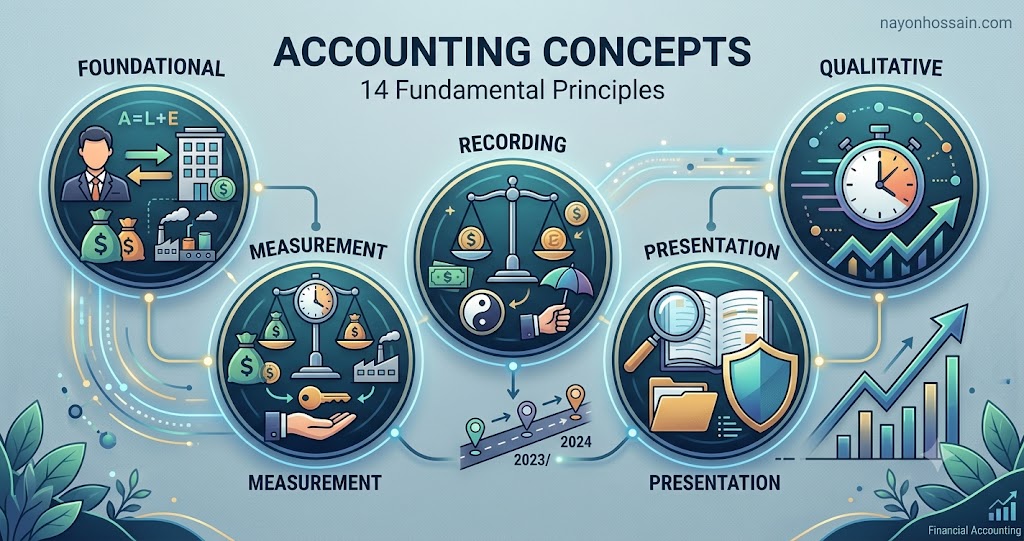
Accounting Concepts: 14 Fundamental Principles Every Accountant Must Know
What Are Accounting Concepts?
Every profession has a set of foundational rules that everyone in the field agrees to follow. In medicine, it is evidence-based practice and the Hippocratic principle of doing no harm. In law, it is precedent and due process.
In accounting, these foundational rules are called accounting concepts also referred to as accounting principles, accounting assumptions, or the conceptual framework of accounting.
Accounting concepts are the fundamental rules, assumptions, and guidelines that govern how financial transactions are recorded, classified, and reported. They ensure that financial statements produced by different businesses, in different countries, at different points in time are prepared on a consistent and comparable basis.
Without these concepts, every business could report its finances however it liked. One company might recognise revenue when cash is received; another when a contract is signed. One might value its buildings at market price; another at cost. Comparing financial statements across companies would be meaningless like comparing distances measured in kilometres to distances measured in miles without converting.
Accounting concepts eliminate that confusion. They create a common language for financial reporting.
These concepts are codified internationally in the IASB Conceptual Framework for Financial Reporting (2018) the document published by the International Accounting Standards Board that underpins all IFRS standards. In the United States, the equivalent is the FASB Conceptual Framework (Statements of Financial Accounting Concepts, SFAC). In Bangladesh, the BFRS Conceptual Framework adopted from IASB governs financial reporting for all entities applying Bangladesh Financial Reporting Standards.
For CA students including those sitting ICAB, ICAI, ACCA, and CIMA, accounting concepts are not abstract theory. They appear in exam questions at every level, and more importantly, they underpin every practical accounting decision made in professional life.
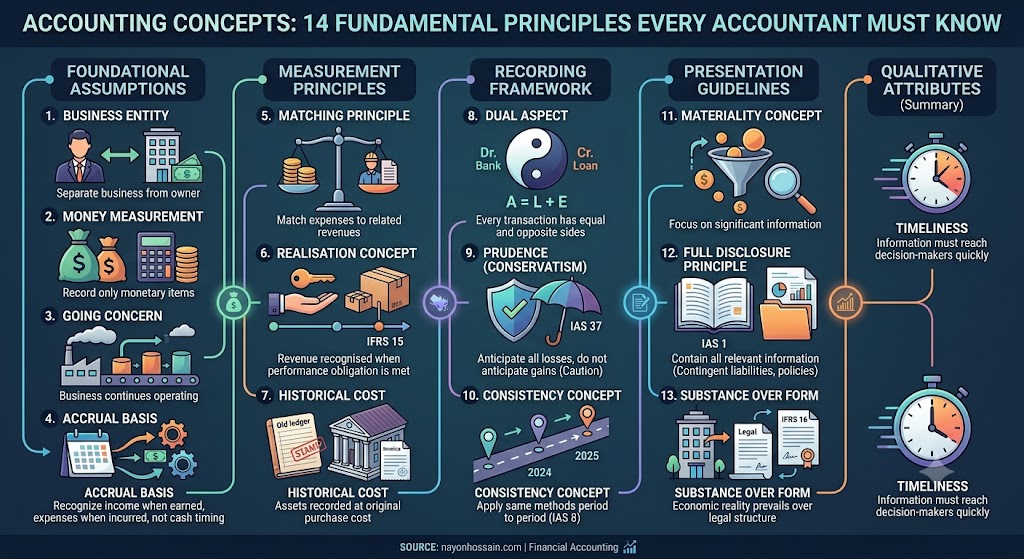
Two Categories: Concepts and Conventions
Before covering each concept individually, it helps to understand that accounting principles are typically grouped into two categories:
Accounting Concepts (Fundamental Assumptions): These are the basic assumptions underlying all financial statements. They are so fundamental that they are assumed to be present unless explicitly stated otherwise. The key ones are the going concern assumption, the accrual basis, and the consistency concept.
Accounting Conventions (Modifying Principles): These are practical guidelines that modify how the concepts are applied in specific situations. They include prudence (conservatism), materiality, substance over form, and full disclosure.
In practice, both categories are collectively referred to as “accounting concepts” or “accounting principles” especially in South Asian CA curricula where the combined list is a staple examination topic.
We will cover both categories together, noting where each sits.
1. Business Entity Concept
What it is:
The business entity concept states that a business is treated as a completely separate legal and accounting entity from its owners, shareholders, and other businesses even if the same person owns multiple businesses.
Only the transactions of the business are recorded in the business’s books. The personal transactions of the owner are completely excluded.
Simple example:
Karim owns a trading company. He also owns a house personally. Under the business entity concept, the house is Karim’s personal asset, it does not appear anywhere in the company’s accounts. If Karim withdraws cash from the business for personal use, it is recorded as drawings (a reduction of capital) not as an expense of the business.
Why it matters:
Without this concept, a business’s financial statements would mix personal and business finances making it impossible to assess the true profitability and financial position of the business itself. Lenders, investors, and tax authorities all rely on this separation.
Under IFRS / BFRS: The IASB Conceptual Framework identifies the reporting entity as the boundary within which financial information is reported. The entity concept is the foundation of this boundary.
US GAAP: SFAC No. 6 defines an entity as an economic unit that controls resources and incurs obligations. The entity assumption is one of the foundational assumptions underlying US financial reporting.
2. Money Measurement Concept (Monetary Unit Assumption)
What it is:
The money measurement concept states that only transactions and events that can be measured reliably in monetary terms are recorded in the accounts.
Events or facts that cannot be given a monetary value however important are not included in the financial statements.
Simple examples:
A company’s accounts will record: the purchase of machinery for $50,000, the payment of salaries, the receipt of a customer payment.
A company’s accounts will NOT record: the fact that the CEO is a brilliant strategist, the company’s brand reputation, employee morale, a looming lawsuit that has no dollar figure yet, or a long-standing customer relationship that generates $2 million per year.
These are real, valuable things but they cannot be reliably measured in money, so they stay off the balance sheet.
Why it matters:
Money provides a common unit of measurement that makes it possible to add, subtract, and compare different types of transactions. Without monetary measurement, accounting cannot function as a systematic information system.
The limitation:
The money measurement concept has a well-known weakness: it excludes some of the most important assets a business has its human capital, brand reputation, management quality, and customer loyalty. A business may have an outstanding workforce and a sterling brand but these appear nowhere on the balance sheet. This is why intangible assets are one of the most debated areas in financial reporting.
The concept also assumes that the monetary unit (the currency) is stable in value over time. In practice, inflation erodes the purchasing power of money $1 today buys less than $1 did ten years ago. Historical cost accounting ignores this, which is why some jurisdictions permit or require inflation-adjusted (current cost) accounting for high-inflation environments.
3. Going Concern Concept
What it is:
The going concern concept assumes that a business will continue to operate for the foreseeable future that it has neither the intention nor the necessity to liquidate or curtail its operations materially.
Why it fundamentally matters:
This assumption drives the entire basis of asset valuation in financial statements. Assets are recorded at historical cost (or depreciated cost) because the business will continue using them. If a business were about to close, assets would be valued at break-up (liquidation) value which is almost always much lower.
Simple example:
A manufacturing company owns machinery it purchased for $500,000. After depreciation, the net book value is $200,000. But if the company tried to sell this specialist machinery second-hand, it might only fetch $40,000.
Under the going concern assumption: machinery is shown at $200,000 (book value because it will continue to be used).
If going concern is NOT valid: machinery might need to be written down to $40,000 (break-up value because it must be sold).
When the assumption is challenged:
The going concern assumption must be assessed by management and the auditor at every reporting period. Under IAS 1 — Presentation of Financial Statements, management must assess whether there are material uncertainties that cast significant doubt on the entity’s ability to continue as a going concern. If such doubts exist, they must be disclosed.
Under ISA 570 (Revised) — Going Concern, auditors have specific responsibilities to evaluate whether the going concern assumption is appropriate. If the auditor concludes that the assumption is not appropriate but management has still prepared the accounts on that basis, a modified audit opinion is issued.
Signs that may threaten going concern: persistent trading losses, significant net current liability position, loss of a key customer, major legal judgement against the company, or inability to refinance borrowings.
4. Accrual Concept (Accrual Basis)
What it is:
The accrual concept states that transactions are recognised in the period to which they relate not in the period when cash is received or paid.
Income is recognised when it is earned. Expenses are recognised when they are incurred. The timing of cash is irrelevant.
Simple examples:
A consultancy completes a project in December 2024. The client pays in February 2025. Under the accrual concept, the revenue is recognised in December 2024 when the work was done not in February 2025 when cash arrives.
A company receives its December electricity bill in January 2025. Under the accrual concept, the electricity expense is recognised in December 2024 when the electricity was consumed not in January 2025 when the bill arrives or when it is paid.
Why it is foundational:
The accrual concept is arguably the most important of all accounting concepts. It is what distinguishes financial accounting from simple cash-based bookkeeping.
Without accrual accounting, profit could be manipulated easily simply by accelerating cash collections or delaying payments. Accrual accounting prevents this by tying profit recognition to economic activity rather than cash movements.
Under IFRS: The IASB Conceptual Framework (2018, paragraph 1.17) explicitly states that financial statements prepared on an accrual basis “depict the effects of transactions and other events and circumstances on a reporting entity’s economic resources and claims in the periods in which those effects occur, even if the resulting cash receipts and payments occur in a different period.”
US GAAP: Accrual accounting is the required basis for all US GAAP financial statements (SFAC No. 6).
The accrual concept is the theoretical basis behind: prepaid expenses, accrued expenses, deferred revenue, accrued income all the adjusting entries covered in our prepaid insurance article.
5. Matching Concept (Matching Principle)
What it is:
The matching concept states that expenses should be matched to (recognised in the same period as) the revenues they helped generate.
If an expense is incurred to produce revenue in a specific period, that expense should be recognised in that same period regardless of when cash is paid.
Simple example:
A company pays $120,000 commission to its sales team in January 2025 for sales they made in December 2024. Under the matching concept, the commission expense belongs in December 2024 when the sales were made and the revenue was earned not in January 2025 when the cash is paid.
Connection to accrual concept:
The matching concept is closely related to the accrual concept, it is, in fact, a specific application of it. Accrual accounting provides the timing rule; the matching principle specifies that costs should follow the revenues they produce.
Where matching is straightforward:
Direct costs of sale materials, direct labour, sales commissions can be directly matched to specific revenue transactions.
Where matching requires judgment:
Indirect costs and overheads cannot be directly matched to specific sales. Instead, they are allocated to periods based on systematic methods depreciation is the prime example. A machine purchased for $100,000 with a 10-year life is depreciated at $10,000 per year because it contributes to revenue generation in each of those 10 years.
Under IFRS: The matching principle is embedded in the IASB framework but is not explicitly called “matching” instead, it flows from the definition of expenses (decreases in assets or increases in liabilities that result in decreases in equity, other than distributions to holders of equity claims) and the accrual basis.
6. Realisation Concept (Revenue Recognition)
What it is:
The realisation concept states that revenue is recognised only when it has been earned that is, when the right to receive payment has been established and it is reasonable to expect that payment will be received.
Revenue is not recognised when a contract is signed, when a deposit is received, or when an order is placed. It is recognised when the performance obligation has been fulfilled.
Simple examples:
A retailer sells a television on 28 December 2024. The customer pays cash immediately. Revenue is recognised on 28 December the point of sale.
A construction company signs a $10 million contract in January 2024 to build a facility over 18 months. The company does not recognise $10 million on the day of signing. Revenue is recognised progressively as construction work is completed.
The international standard:
Under IFRS 15 — Revenue from Contracts with Customers (which replaced IAS 18 and IAS 11), revenue is recognised when (or as) a performance obligation is satisfied when control of the promised good or service is transferred to the customer. IFRS 15 introduced a rigorous five-step model:
- Identify the contract with the customer
- Identify the performance obligations in the contract
- Determine the transaction price
- Allocate the transaction price to the performance obligations
- Recognise revenue when (or as) each performance obligation is satisfied
US GAAP equivalent: ASC 606 — Revenue from Contracts with Customers (converged with IFRS 15).
The realisation concept prevents businesses from recognising revenue prematurely — a common form of earnings manipulation.
7. Historical Cost Concept (Cost Principle)
What it is:
The historical cost concept states that assets are initially recorded in the accounts at their original purchase cost (historical cost) not at current market value, replacement cost, or any other value.
Simple example:
A company buys a building for $800,000 in 2015. By 2024, similar buildings in the area sell for $1.5 million. Under historical cost accounting, the building remains on the balance sheet at $800,000 (less accumulated depreciation) not at $1.5 million.
Why historical cost is used:
- Objectivity: The original purchase cost is a verifiable, objective fact supported by a transaction document. Market values are subjective two different valuers may produce different estimates.
- Reliability: Historical cost does not change unless the asset is revalued or impaired making financial statements more stable and harder to manipulate.
- Verifiability: Auditors can easily verify historical cost against purchase invoices. Verifying current market value requires judgement and external valuation.
The limitation:
Historical cost may significantly understate the value of long-held assets particularly land and property during periods of inflation. A balance sheet showing land at $200,000 (purchased 30 years ago) when its current market value is $5 million is technically correct under historical cost but practically misleading.
Alternatives permitted under IFRS:
Under IAS 16 — Property, Plant and Equipment, companies may choose to use the revaluation model carrying fixed assets at fair value, updated regularly. Under IAS 40 — Investment Property, investment properties may be carried at fair value through profit or loss.
Under US GAAP, the historical cost model is used far more strictly most assets remain at historical cost, with limited exceptions for financial instruments (ASC 820 — Fair Value Measurement).
The tension between historical cost and fair value is one of the most actively debated topics in financial reporting standard-setting.
8. Dual Aspect Concept (Double Entry Principle)
What it is:
The dual aspect concept states that every business transaction has two aspects a receiving aspect and a giving aspect and both must be recorded. This is the conceptual foundation of double-entry bookkeeping.
In accounting terms: for every debit, there is an equal and opposite credit. The accounting equation — Assets = Liabilities + Equity must always remain in balance.
Simple example:
A company borrows $50,000 from a bank.
- Receiving aspect: The company receives $50,000 cash (an asset increases — Debit)
- Giving aspect: The company now owes $50,000 to the bank (a liability increases — Credit)
Dr. Bank (Asset +)       50,000
    Cr. Loan Payable (Liability +)   50,000
Both sides of the equation are affected equally. The balance sheet remains in balance.
Why it matters:
Double-entry bookkeeping derived from the dual aspect concept has been the global standard in accounting for over 500 years. It was first systematically described by Luca Pacioli, an Italian mathematician, in his 1494 work Summa de Arithmetica though merchants had been using it informally for decades before.
The dual aspect concept is what makes it possible to detect errors (if debits ≠ credits, something is wrong), produce a trial balance, and ultimately prepare complete financial statements.
International application: Double-entry bookkeeping is universal. Whether you use IFRS, US GAAP, or any other framework, the dual aspect concept is the mechanical engine underlying all of it.
9. Prudence Concept (Conservatism)
What it is:
The prudence concept states that when there is uncertainty, accountants should err on the side of caution:
- Losses and liabilities should be recognised as soon as they are anticipated, even if not yet certain.
- Gains and assets should be recognised only when they are reasonably certain.
In plain terms: anticipate losses, do not anticipate profits.
Simple examples:
A company is involved in a lawsuit. Legal counsel advises that there is a 70% probability of losing and paying $200,000. Under prudence, the company provisions (records) $200,000 as a liability and expense immediately even though the lawsuit has not been settled.
The same company has a strong claim for a $300,000 tax refund. Under prudence, this is not recognised as income until the refund is confirmed even if management is confident it will be received.
Under IFRS — important nuance:
The 2018 revision of the IASB Conceptual Framework reintroduced prudence as a component of neutrality specifically, the exercise of caution in conditions of uncertainty. However, it explicitly stated that prudence does not mean deliberate understatement of assets or overstatement of liabilities. Asymmetric prudence (treating gains and losses differently) is no longer considered the primary approach under pure IFRS.
Under IAS 37 — Provisions, Contingent Liabilities and Contingent Assets, the prudence concept is operationalised: provisions are recognised when there is a present obligation, an outflow is probable, and the amount can be reliably estimated.
Under traditional GAAP and CA curriculum (India, Bangladesh): Prudence is taught more assertively anticipate all losses, do not anticipate profits in its classic conservative form.
10. Consistency Concept
What it is:
The consistency concept states that once an accounting policy or method has been adopted, it should be applied consistently from one period to the next. Methods should not be changed unless there is a valid reason.
Simple example:
A company uses the straight-line method to depreciate its machinery. Under the consistency concept, it must use straight-line every year — not switch to the reducing balance method one year because it produces a lower depreciation charge (and therefore higher profit), then switch back the next year.
Why it matters:
Consistency makes financial statements comparable one of the key qualitative characteristics of useful financial information under the IASB Conceptual Framework. Year-on-year comparisons only make sense if the same methods have been applied throughout.
Does this mean methods can never change?
No — accounting policies can be changed, but only when:
- Required by a new or revised accounting standard, or
- The change results in more reliable and relevant information about the financial position and performance of the entity
When an accounting policy is changed, the change must be disclosed and, where practicable, applied retrospectively (restating prior period comparatives as if the new policy had always been applied). This ensures comparability is maintained.
Under IAS 8 — Accounting Policies, Changes in Accounting Estimates and Errors, the rules governing policy changes, changes in estimates, and prior period error corrections are set out in detail.
11. Materiality Concept
What it is:
The materiality concept states that financial statements need only disclose information that is material that is, information whose omission or misstatement could reasonably be expected to influence the economic decisions of users.
Immaterial items may be treated in the most convenient and expedient manner, even if that departs from strict accounting rules.
Simple example:
A company buys a stapler for $8. Strictly speaking, this is an asset with a useful life of several years. Under the matching principle, it should be capitalised and depreciated. But the cost is trivially small, it is immaterial. In practice, businesses write it off as office supplies expense immediately. No user of the financial statements would change their decision based on whether the stapler is on the balance sheet or not.
What determines materiality?
Materiality is a matter of judgment. Factors include:
- The size of the item relative to total assets, revenue, or profit
- The nature of the item — some items are qualitatively material regardless of size (e.g., related-party transactions, going concern issues, fraud)
- The context — an item that is immaterial for a large company may be highly material for a small one
Under IFRS:
The IASB Conceptual Framework (2018, paragraph 2.11) defines material as: “Information is material if omitting, misstating or obscuring it could reasonably be expected to influence decisions that the primary users of a specific reporting entity’s general purpose financial statements make on the basis of those financial statements.”
IAS 1 reinforces that each material class of similar items must be presented separately in the financial statements; immaterial items can be aggregated.
The IASB Practice Statement 2 (2017) — Making Materiality Judgements provides practical guidance on applying materiality in the preparation and disclosure of financial statements.
12. Full Disclosure Principle
What it is:
The full disclosure principle states that financial statements should contain all information necessary to make them not misleading to a reasonable user. Any fact that could significantly affect the understanding of the financial position or performance must be disclosed either in the primary statements or in the notes.
What full disclosure covers:
- Accounting policies adopted (so users understand the basis of preparation)
- Changes in accounting policies and estimates
- Contingent liabilities (potential future obligations)
- Events after the reporting period
- Related party transactions
- Segment information for diversified businesses
- Commitments (e.g., future lease payments, capital expenditure contracted)
- Financial risk exposures
Simple example:
A company has a $5 million contingent liability from ongoing litigation. The lawsuit may never result in a payment or may result in a large one. Under full disclosure, this must be disclosed in the notes to the financial statements, even though no amount is recognised on the face of the balance sheet (unless a provision is required under IAS 37).
Where this is applied:
IAS 1 requires disclosure of all significant accounting policies.
IFRS 7 — Financial Instruments: Disclosures requires extensive disclosures about financial risk.
IAS 24 — Related Party Disclosures requires disclosure of all transactions with related parties.
IAS 10 — Events after the Reporting Period governs disclosure of significant events after the balance sheet date.
The tension with materiality:
Full disclosure and materiality operate together. The full disclosure principle is moderated by materiality only material information needs to be disclosed. Disclosing everything, regardless of significance, would bury important information under an avalanche of trivial detail.
In practice, finding the right balance between sufficient and excessive disclosure is a significant challenge for preparers and a key area of review by auditors and regulators.
13. Substance Over Form
What it is:
The substance over form concept states that transactions should be recorded according to their economic substance and commercial reality, not merely their legal form.
If the legal structure of a transaction differs from its economic reality, the economic substance takes priority in the accounts.
Classic example — Finance Leases:
A company enters a 15-year lease for a machine. Legally, the company does not own the machine — it is renting it. But the lease covers virtually the entire economic life of the machine, the company bears all the risks and rewards of ownership, and at the end of the lease the company can buy the machine for a nominal sum.
In economic substance, the company effectively owns the machine. Under IFRS 16 — Leases, the company must record both the asset and the lease liability on its balance sheet recognising the economic substance of ownership even though legal ownership has not passed.
Another example — Sale and Leaseback:
A company sells its headquarters building and simultaneously leases it back under a long-term lease. Legally, a sale has occurred. But if the company retains all the risks and benefits of the building throughout the lease, the economic substance is that no real sale occurred the transaction is a secured borrowing. Under IFRS 16, careful assessment is required to determine whether the transfer qualifies as a sale.
Under IFRS:
The IASB Conceptual Framework (2018) embeds substance over form within the concept of faithful representation information must represent the economic phenomena it purports to represent. Legal form that does not match economic substance fails to faithfully represent reality.
US GAAP similarly applies substance over form though historically US GAAP has been more rules-based, sometimes allowing legal form to prevail where specific rules exist.
14. Timeliness
What it is:
Timeliness states that financial information must be available to decision-makers before it loses its capacity to influence decisions. Old information has diminishing value markets move, decisions are made with or without the information, and by the time late reports arrive, the window for action has often passed.
Why it matters in practice:
Listed companies are required to publish results within defined timeframes typically 60 to 90 days after year-end for annual reports, and 30 to 45 days after quarter-end for interim reports. These deadlines exist because markets need timely information.
The trade-off with reliability:
Timeliness sometimes conflicts with the desire for complete accuracy. The faster financial statements are produced, the less time there is to verify every figure. The IASB Conceptual Framework acknowledges this trade-off: “If reporting is delayed until all aspects of a transaction are known, the information may be highly faithful but of little use to users who have had to make decisions in the interim.”
This is why interim financial statements though potentially less precise than year-end statements are still highly valuable.
How These Concepts Work Together
These concepts are not isolated rules — they form an interconnected system where each concept reinforces and constrains the others.
The accrual concept and matching concept work together to ensure income and expenses are recognised in the right period.
The prudence concept modifies the realisation concept — be conservative about recognising gains but prompt about recognising losses.
Materiality moderates both full disclosure and consistency — only material policies need to be disclosed; only material departures from consistency need to be flagged.
Substance over form modifies the cost concept — if the economic substance of a transaction differs from its legal form, substance prevails over the legal cost-based recording.
The going concern concept underpins the historical cost concept — assets are carried at cost (not liquidation value) precisely because the business is assumed to be continuing.
Understanding how these concepts interact is what separates a technically competent accountant from a genuinely skilled one. Real-world accounting problems almost never call for the application of a single concept — they require the simultaneous judgement of several, often in tension with each other.
A Note on the IASB Conceptual Framework
For any student or professional working under IFRS (including BFRS in Bangladesh), the IASB Conceptual Framework for Financial Reporting (2018) is the primary authoritative source for accounting concepts.
The framework identifies:
Qualitative characteristics of useful financial information:
- Fundamental: Relevance and Faithful Representation
- Enhancing: Comparability, Verifiability, Timeliness, Understandability
These are not separate concepts from the ones discussed above, they are the overarching framework within which concepts like consistency (comparability), full disclosure (faithful representation), timeliness, and materiality (relevance threshold) sit.
The framework also defines the elements of financial statements assets, liabilities, equity, income, and expenses which form the foundation of every financial statement. These definitions underpin how the concepts are applied in practice.
Quick Reference Summary
| Concept | Core Idea | Key Standard |
|---|---|---|
| Business Entity | Business is separate from its owners | IASB Conceptual Framework |
| Money Measurement | Only measurable monetary items are recorded | IASB Conceptual Framework |
| Going Concern | Business assumed to continue operating | IAS 1; ISA 570 |
| Accrual | Recognise income/expense when earned/incurred, not when cash moves | IAS 1; IASB Framework |
| Matching | Match expenses to the revenues they produce | IASB Framework |
| Realisation | Revenue recognised when earned / performance obligation met | IFRS 15; ASC 606 |
| Historical Cost | Assets recorded at original purchase cost | IAS 16; IAS 2 |
| Dual Aspect | Every transaction has two equal and opposite sides | Universal — double entry |
| Prudence | Caution under uncertainty — anticipate losses, not gains | IAS 37; IASB Framework |
| Consistency | Same methods applied period to period | IAS 8 |
| Materiality | Disclose only information significant enough to affect decisions | IAS 1; IASB Framework |
| Full Disclosure | All material information must be disclosed | IAS 1; IFRS 7; IAS 24 |
| Substance Over Form | Economic reality prevails over legal form | IASB Framework; IFRS 16 |
| Timeliness | Information must reach users promptly enough to be useful | IASB Framework |
Frequently Asked Questions (FAQs)
There is no single most important concept, they work as a system. But if pressed, the accrual concept is arguably the most foundational because it determines the timing of recognition for virtually every transaction in financial statements, and it is what distinguishes accounting from simple cash-based record-keeping.
No — but they are related. Accounting concepts are the overarching principles and assumptions that all standards must be consistent with. Accounting standards (like IFRS, IAS, BFRS, US GAAP) are more specific rules that apply the concepts to particular types of transactions and situations. Standards are developed within the framework that the concepts establish.
Not exactly. Under the revised IASB Conceptual Framework (2018), prudence means exercising caution in conditions of uncertainty, it does not mean systematic understatement of assets or overstatement of liabilities. The goal is neutrality presenting financial information that is neither overly optimistic nor overly pessimistic. The old conservative interpretation of prudence (always understate profits) has been moderated in the modern IFRS framework.
Solvency refers to whether a company can meet its financial obligations (whether liabilities exceed assets). Going concern relates to the longer-term question of whether the business will continue to operate. A company can be technically solvent but still face going concern doubts for example, if it has adequate assets but is haemorrhaging cash and cannot raise new financing.
The same concepts apply to all businesses that prepare financial statements under BFRS or even under a simplified framework. The Bangladesh Financial Reporting Standard for Small and Medium Entities (BFRS for SMEs) applies these same fundamental concepts in a simplified form appropriate for businesses that are not publicly accountable.
References
- International Accounting Standards Board (IASB). Conceptual Framework for Financial Reporting. 2018. Available at: ifrs.org
- IASB. IAS 1 — Presentation of Financial Statements. Available at: ifrs.org
- IASB. IAS 2 — Inventories. Available at: ifrs.org
- IASB. IAS 8 — Accounting Policies, Changes in Accounting Estimates and Errors. Available at: ifrs.org
- IASB. IAS 16 — Property, Plant and Equipment. Available at: ifrs.org
- IASB. IAS 37 — Provisions, Contingent Liabilities and Contingent Assets. Available at: ifrs.org
- IASB. IFRS 15 — Revenue from Contracts with Customers. Available at: ifrs.org
- IASB. IFRS 16 — Leases. Available at: ifrs.org
- IASB. Practice Statement 2 — Making Materiality Judgements. 2017. Available at: ifrs.org
- International Auditing and Assurance Standards Board (IAASB). ISA 570 (Revised) — Going Concern. Available at: iaasb.org
- Financial Accounting Standards Board (FASB). Statements of Financial Accounting Concepts (SFAC) No. 1–8. Available at: fasb.org
- FASB. ASC 606 — Revenue from Contracts with Customers. Available at: fasb.org
- Institute of Chartered Accountants of Bangladesh (ICAB). BFRS Conceptual Framework and Professional Level Financial Reporting Study Material. Available at: icab.org.bd
- Pacioli, L. Summa de Arithmetica, Geometria, Proportioni et Proportionalità. Venice, 1494. (Historical origin of double-entry bookkeeping)
- Alexander, D. and Nobes, C. Financial Accounting: An International Introduction. 7th edition. Pearson, 2020. (Chapters on conceptual framework and accounting concepts)
