
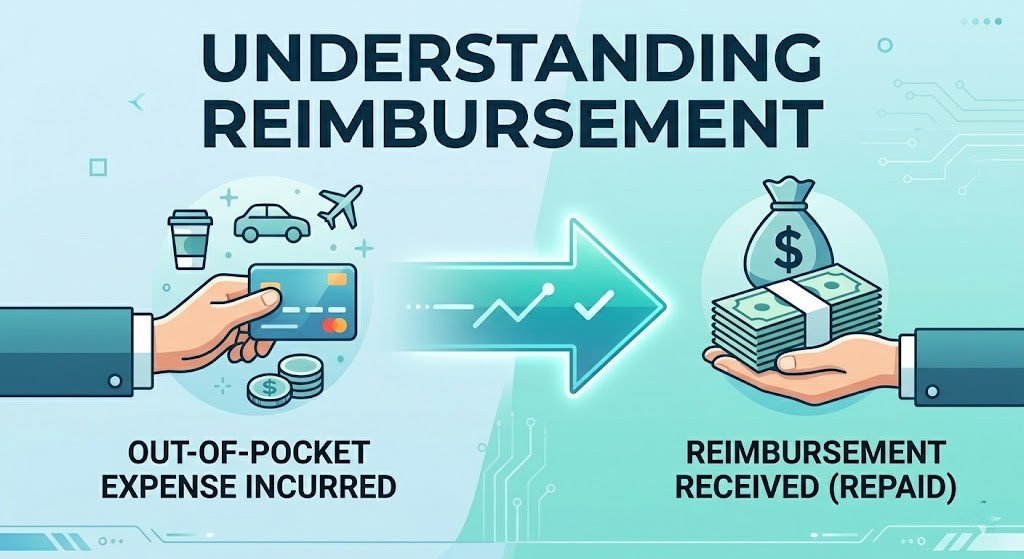
What is Reimbursement? (Simple Definition)
You attend a business conference on behalf of your company. You pay for the flight, hotel, and meals from your own pocket — spending $850 of your personal money. When you return, your company pays that $850 back to you.
That payment back to you is called a reimbursement.
Reimbursement is the act of repaying someone for money they have already spent on behalf of another party.
The key idea is simple: one person or organisation spends money first, and the other pays them back later. The person who spent the money is not losing anything permanently, they are being restored to their original financial position.
Reimbursement appears everywhere in business and personal life:
- A company repays an employee’s travel expenses
- A health insurance company pays back a policyholder’s medical bills
- A government refunds overpaid taxes
- A law firm bills a client back for court filing fees paid on their behalf
- A project owner repays a contractor for materials purchased for a construction job
In all these cases, the same structure applies: one party spends money, and the party on whose behalf it was spent pays it back.
The word reimburse comes from the Latin bursus (meaning purse or money bag) combined with the prefix re (meaning again). Literally: to refill the purse again.
Reimbursement vs Compensation vs Allowance: The Key Differences
These three words are often confused because they all involve money changing hands between an employer and employee. But they mean very different things both in everyday language and in accounting.
Reimbursement is a repayment for an actual, documented expense already spent. The amount equals the exact amount spent. It is not income, it is the return of money that was already yours.
Example: You spent $120 on a client dinner. Your company pays you back $120. That is reimbursement.
Allowance is a fixed payment given to an employee for a particular purpose regardless of what they actually spend. The employee receives the allowance whether they spend it or not, and they keep any unspent balance.
Example: Your company pays you a $200 monthly transport allowance. Even if you only spend $150 on transport, you receive $200. That $50 unspent is yours to keep.
Compensation (or salary) is payment for services rendered for the work you do. It is income, not a repayment of any expense.
| Feature | Reimbursement | Allowance | Salary/Compensation |
|---|---|---|---|
| Based on | Actual documented expense | Fixed amount, regardless of spending | Work performed |
| Requires receipts? | Yes — proof of spending | Usually no | No |
| Amount | Exact amount spent | Fixed predetermined figure | Agreed rate |
| Taxable? | Generally no (returning your own money) | Often yes (it is income) | Yes |
| Accounting treatment | Reduces a liability or records an expense | Records an expense | Records a salary expense |
This distinction matters for tax purposes: reimbursements are generally not taxable income to the recipient, whereas allowances may be partially or fully taxable depending on jurisdiction and how they are structured.
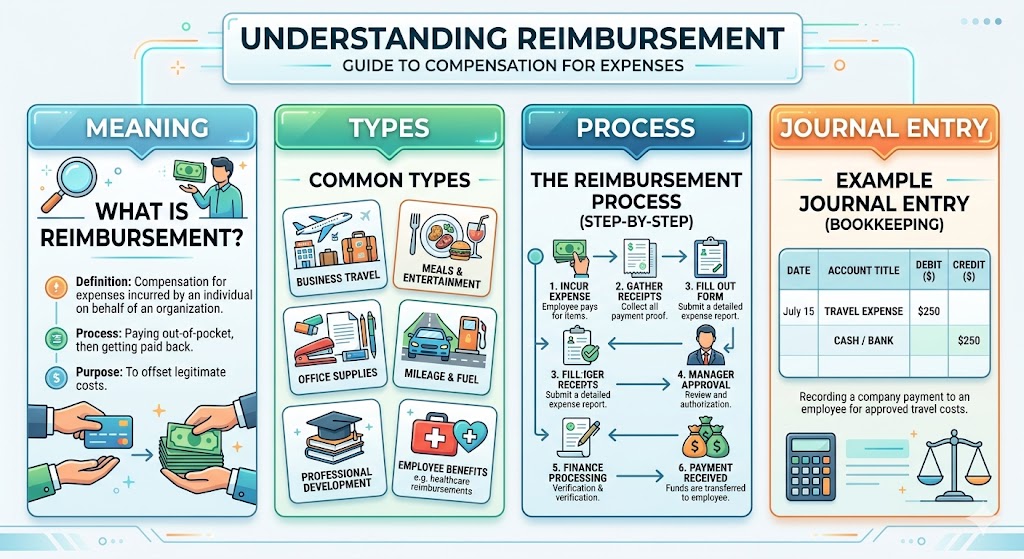
Types of Reimbursement
Reimbursement takes many forms depending on the context. Here are the most common types.
1. Employee Expense Reimbursement
This is the most common type in business. An employee spends personal money on legitimate business expenses and submits a claim for repayment by the employer.
Common employee expenses that are reimbursed:
- Travel expenses — flights, train tickets, fuel costs, taxi fares, Uber/Pathao rides to meetings or client sites
- Accommodation — hotels during business trips
- Meals and entertainment — client dinners, working lunches, team meals during travel
- Office supplies — stationery, printing costs, minor equipment bought personally for work use
- Professional development — exam fees, professional membership renewals, training course fees
- Communication costs — work-related phone calls made on a personal phone, internet top-ups used for remote work
- Postage and courier — sending documents or packages for work purposes
Practical example:
Farhan, a sales manager at a Dhaka-based export firm, drives 200 kilometres to visit a major client in Narsingdi. He pays BDT 3,200 for fuel, BDT 1,500 for lunch with the client, and BDT 500 for toll fees. His total out-of-pocket business expense is BDT 5,200.
He submits an expense claim with receipts. His company reimburses BDT 5,200. Farhan is financially restored to where he was before the trip — he has neither gained nor lost money personally.
2. Medical / Health Insurance Reimbursement
When a policyholder pays for medical treatment out of pocket and then submits a claim to their insurance company, the insurer repays the eligible costs. This is a reimbursement arrangement common in indemnity-based health insurance plans.
Example: A patient undergoes a surgical procedure costing BDT 80,000 at a private hospital. Their health insurance plan covers 80% of hospitalisation costs. The patient pays BDT 80,000 upfront, then submits all bills to the insurer. The insurer reimburses BDT 64,000 (80% × 80,000).
This contrasts with a cashless insurance arrangement, where the hospital bills the insurer directly and the patient pays nothing — or just the co-pay — at the point of treatment. The reimbursement model requires the patient to pay first and claim back.
3. Tax Reimbursement (Tax Refund)
When a taxpayer pays more tax during the year than they actually owe — through payroll withholding, advance tax payments, or estimated tax payments — the tax authority owes them a refund. That refund is a reimbursement of the excess tax paid.
Example: A salaried employee has BDT 36,000 withheld from their pay throughout the year for income tax. When they file their annual tax return, the actual tax liability is calculated as BDT 29,000. The National Board of Revenue (NBR) owes a refund of BDT 7,000 a tax reimbursement.
4. Client / Project Reimbursement (Pass-Through Expenses)
When a service provider (lawyer, consultant, accountant, contractor) incurs costs specifically for a client’s project, those costs are often billed back to the client. This is called a pass-through or billable expense the service provider is reimbursed by the client for costs they paid on the client’s behalf.
Example: A law firm files court documents on behalf of a client, paying BDT 12,000 in court filing fees. The law firm then invoices the client for BDT 12,000 as a disbursement reimbursement, in addition to their professional fees.
The law firm is not making a profit on this BDT 12,000, they are simply getting their money back. The real cost is borne by the client; the law firm acted as a temporary financing arrangement.
5. Government / Insurance Reimbursement to Businesses
Governments and insurance companies sometimes reimburse businesses for costs incurred under specific schemes:
- Export subsidies — where a government reimburses part of the cost of exporting goods to encourage trade
- Training grant reimbursements — where a government scheme reimburses employers for eligible staff training costs
- Business insurance claims — where an insurer reimburses a business for losses from fire, theft, flood, or business interruption
In Bangladesh, various export incentive schemes administered by the Export Promotion Bureau (EPB) and Bangladesh Bank involve reimbursements to exporters for certain qualifying costs.
6. Educational / Tuition Reimbursement
Many employers offer tuition reimbursement programmes, where the company repays employees for the cost of approved educational courses, professional qualifications, or academic programmes particularly when the study is relevant to the employee’s role.
Example: A company agrees to reimburse up to BDT 50,000 per year toward an employee’s ACCA exam fees and study materials. The employee pays the fees and provides proof of payment. The company then reimburses the documented amount.
These programmes are used by employers to invest in staff development and improve retention. For employees, it is an excellent benefit — particularly for those pursuing CA, ACCA, CMA, or MBA qualifications.
The Employee Expense Reimbursement Process: Step by Step
For most accountants and finance professionals, employee expense reimbursement is the most operationally significant type. Here is how a well-run reimbursement process works:
Step 1: Employee Incurs the Expense
The employee pays for a legitimate business expense using personal funds. At this stage, the expense exists but the company has not yet recorded or reimbursed it.
Best practice: get a receipt for every expense, no matter how small.
Step 2: Employee Completes an Expense Claim Form
The employee fills in an expense claim form (also called an expense report or reimbursement request) listing:
- Date of expense
- Nature of expense (travel, meals, accommodation, etc.)
- Amount
- Business purpose (who was met, what was the business reason)
- Receipts attached
Without this documentation, the company cannot verify the claim, and tax authorities may not accept it as a deductible business expense.
Step 3: Line Manager / Supervisor Approves
The completed form with attached receipts goes to the employee’s direct supervisor for approval. The supervisor confirms:
- The expense is legitimate and business-related
- It falls within company policy (correct expense category, within spending limits)
- The business purpose is genuine
This approval step is an important internal control — it prevents abuse of the reimbursement process.
Step 4: Finance / Accounts Team Reviews and Processes
The approved form goes to the finance team, who:
- Verify the arithmetic (total matches individual items)
- Check receipts are valid and match claimed amounts
- Confirm expenses comply with the company’s expense policy
- Code each expense to the correct account (travel expense, entertainment expense, etc.)
- Prepare payment — bank transfer to the employee’s account or cash payment
Step 5: Reimbursement is Paid to the Employee
The employee receives the reimbursed amount — usually by bank transfer alongside or separately from their salary. The expense claim is then filed for record-keeping.
Step 6: Finance Team Posts the Accounting Entry
The journal entry is recorded in the books. The individual expense accounts are debited and cash/bank is credited.
Journal Entry for Reimbursement: The Accounting Treatment
How reimbursement is recorded in the accounts depends on the type and timing. Let us cover the most common scenario: employee expense reimbursement.
Scenario 1: Reimbursed in the Same Period as Incurred
The simplest case — an employee spends money this month and is reimbursed this month.
Facts: Farhan spends BDT 5,200 on a business trip (fuel: 3,200, meals: 1,500, tolls: 500). He is reimbursed the same week.
Journal Entry when reimbursement is paid:
Dr. Travel Expense               3,200
Dr. Entertainment Expense        1,500
Dr. Miscellaneous Expense          500
    Cr. Cash / Bank                    5,200

Narration: Reimbursement of business trip expenses to
           Farhan (Sales Manager) per approved expense claim.
This is clean and simple: expense is recognised when paid. The balance sheet is unaffected — cash goes out, expense goes up.
Scenario 2: Expense Incurred This Period, Reimbursed Next Period (Accrual Basis)
Under the accrual basis, if an employee has incurred a business expense but the reimbursement has not yet been paid by the period end, the expense should still be recognised in the current period — with a corresponding liability (amount owed to employee).
Step 1: At period end — recognise the expense and liability:
Dr. Travel Expense               5,200
    Cr. Employee Reimbursements Payable   5,200

Narration: Accrual — business trip expenses incurred by Farhan,
           reimbursement pending as at 31 December 2024.
Step 2: When reimbursement is actually paid:
Dr. Employee Reimbursements Payable   5,200
    Cr. Bank                               5,200

Narration: Payment of reimbursement to Farhan per
           approved expense claim dated 28 December 2024.
The liability is cleared when cash is paid. The expense was correctly recognised in the period it was incurred — consistent with the matching principle.
Scenario 3: Client Reimbursement (Pass-Through Expense)
A consultancy firm pays BDT 12,000 in printing and courier costs specifically for a client project. The client is billed back for these costs.
Step 1: When the consultancy pays the costs:
Dr. Reimbursable Expenses / Disbursements   12,000
    Cr. Bank                                    12,000

Narration: Printing and courier costs incurred for
           Client XYZ project — to be billed.
Step 2: When the client is billed:
Dr. Accounts Receivable                     12,000
    Cr. Reimbursable Expenses / Disbursements   12,000

Narration: Invoice to Client XYZ for disbursement
           reimbursement — project expenses.
Step 3: When client pays:
Dr. Bank                12,000
    Cr. Accounts Receivable   12,000
Note: in this structure, the disbursements account nets to zero, the consultancy makes no profit on the reimbursed costs, which is the correct treatment since it is a pure pass-through.
Some firms record pass-through expenses and their recovery as revenue and cost of sales respectively, particularly where the volume is large. Either method is acceptable as long as it is applied consistently and the net effect is the same.
Scenario 4: Insurance Reimbursement Received
A company’s warehouse is damaged by flooding. Repair costs BDT 350,000. The company files an insurance claim and receives BDT 280,000 from the insurer.
Step 1: Record the repair costs paid:
Dr. Repairs & Maintenance Expense   350,000
    Cr. Bank                             350,000
Step 2: Record the insurance reimbursement received:
Dr. Bank / Insurance Claim Receivable   280,000
    Cr. Insurance Reimbursement Income       280,000
The net effect on profit: the company bears a net cost of BDT 70,000 (350,000 repair cost minus 280,000 recovery) the uninsured portion.
Under IAS 37 — Provisions, Contingent Liabilities and Contingent Assets, insurance reimbursements should only be recognised as an asset (receivable) when it is virtually certain the reimbursement will be received. Before that certainty exists, the reimbursement should not be recorded.
Is Reimbursement Taxable?
This is one of the most frequently asked questions about reimbursements — and the answer requires care because it varies by jurisdiction.
The general principle:
A pure reimbursement where the employee is repaid exactly what they spent on a documented, legitimate business expense is generally not taxable income to the employee. They are simply getting their own money back. There is no financial gain.
When reimbursements can become taxable:
If the company reimburses an amount greater than the actual expense, the excess is a benefit and may be taxable. For example, if an employee spent BDT 5,000 but was reimbursed BDT 7,000, the excess BDT 2,000 is income.
If the expense itself was personal rather than business for example, claiming a family holiday as a business trip, the reimbursement is effectively a salary benefit and should be taxed.
If a company pays a blanket travel allowance without requiring proof of actual expenditure, tax authorities may treat it as income rather than reimbursement.
In Bangladesh specifically:
Under the Income Tax Act 2023 and related rules administered by the National Board of Revenue (NBR), reimbursements of genuine business expenses (travel, accommodation, meals for business purposes) supported by proper documentation are generally treated as business costs to the employer and not as taxable income to the employee. However, personal expenses disguised as business reimbursements are both taxable income to the employee and non-deductible for the employer.
Always consult a qualified tax advisor for specific situations, tax treatment of benefits and reimbursements is a detailed area where the facts of each case matter.
What Should a Reimbursement Policy Include?
Any organisation of more than a handful of employees should have a written expense and reimbursement policy. Without clear rules, spending becomes inconsistent, claims become difficult to audit, and abuse becomes more likely.
A good reimbursement policy covers:
Eligible expenses — what categories of spending the company will reimburse. Be explicit: travel, meals with clients, accommodation, professional memberships. And equally explicit about what is not covered: personal expenses, alcohol beyond a stated limit, luxury upgrades (business class when economy was available).
Spending limits — maximum amounts per category. For example: meals up to BDT 2,000 per person per day; hotels up to BDT 8,000 per night; air travel economy class only unless journey exceeds 5 hours.
Documentation requirements — all claims must be supported by original receipts. A receipt must show the date, amount, vendor name, and nature of purchase. Credit card statements alone are usually not sufficient — itemised receipts are needed.
Submission deadlines — claims must be submitted within 30 days of the expense. Late claims may not be processed, or may require additional approval.
Approval hierarchy — who must approve at each spending level. Small claims approved by direct manager; claims above a threshold need Finance Manager or Director approval.
Payment timeline — employees should know how long reimbursement takes once a claim is approved — typically 5 to 15 working days.
Non-compliance consequences — what happens when policy is violated: claims rejected, disciplinary action for fraud, repayment of incorrectly claimed amounts.
A clear policy protects both the organisation (cost control, audit trail) and the employee (clarity on what is acceptable).
Reimbursement in Accounting: The Bigger Picture
From a financial reporting perspective, how reimbursements are treated affects the income statement in an important way.
When a company reimburses an employee, the reimbursed amount becomes a business expense, it reduces the company’s taxable profit. This is why documenting and properly coding reimbursements matters: the right expense code ensures the cost appears in the correct line of the income statement (travel expenses, not salaries; entertainment expenses, not office costs).
From a Value Added Tax (VAT) perspective, if a company reimburses an employee for costs that included VAT, the company may be entitled to reclaim that input VAT but only if the employee obtained a proper VAT invoice in the company’s name. This is a common issue in practice: employees pay suppliers and get a receipt in their own name, which means the company cannot claim back the VAT.
From a management accounting perspective, tracking reimbursements by department, project, or employee allows management to monitor travel and entertainment spending, identify overspending, and compare actual costs to budget. This is why project-based organisations (consulting firms, law firms, construction companies) code all reimbursable expenses to specific project codes.
Real-World Examples: Reimbursement in Different Contexts
Example 1: Sales team business travel
A company’s five-person sales team makes weekly visits to clients across Bangladesh. Each week, they collectively submit expense claims for fuel, bridge tolls, and client meals totalling around BDT 45,000. The company processes and reimburses these claims monthly. Annual reimbursed travel costs: approximately BDT 2.2 million. This is a significant line item in the company’s selling expenses and is carefully budgeted.
Example 2: Remote work equipment
A software company allows remote employees to purchase the equipment they need (desk chair, monitor, keyboard) and submit receipts for reimbursement up to BDT 25,000. The company records this as an equipment or office supplies expense and either reimburses the employee or processes payment directly. In some jurisdictions, employer-provided home office equipment has specific tax treatment.
Example 3: Professional qualification fees
A bank encourages its finance staff to pursue ACCA qualifications and reimburses exam registration fees, study materials, and tuition costs upon passing each paper. The reimbursement is conditional on passing encouraging commitment. The bank records this as a staff training and development expense.
Example 4: Medical emergency abroad
A Bangladeshi company’s employee travels to Singapore for a trade fair. He falls ill and is hospitalised, incurring SGD 3,500 in medical bills. He pays from his personal funds. On return, he submits all bills to the company’s travel insurance provider and to the company’s HR department. The insurance reimburses SGD 3,000; the company covers the remaining SGD 500 not covered by insurance. The employee is fully restored financially.
