Prepaid Insurance: Definition, Journal Entry, Adjusting Entry & Examples

Prepaid Insurance: Definition, Journal Entry, Adjusting Entry & Examples

What is Prepaid Insurance? (Simple Definition)

Imagine your company’s insurance policy runs from 1 October 2024 to 30 September 2025. You pay the full year’s premium $12,000 on 1 October 2024.

But your accounting year ends on 31 December 2024.

By 31 December, only three months of that insurance have actually been used. The remaining nine months of coverage still lie ahead. You have paid for something you have not yet fully received.

That unused, paid-for portion is called prepaid insurance.

Prepaid insurance is the portion of an insurance premium paid in advance that covers a future period. It represents a current asset because it provides an economic benefit, insurance coverage, that the business has not yet consumed.

Prepaid insurance is one of the most common examples of a prepaid expense, an expense paid in cash before it is actually incurred.

Other names you may encounter for the same concept:

  • Prepaid premium
  • Unexpired insurance
  • Insurance paid in advance
  • Deferred insurance expense

They all mean the same thing: money paid for insurance coverage that relates to a future period.

Why is Prepaid Insurance an Asset, Not an Expense?

This is the question that trips up most beginners. You paid cash  so why is it not an expense?

The answer lies in one of the most fundamental principles in accounting: the matching principle (also called the accrual basis of accounting).

Under the accrual basis, expenses are recognised in the period they are incurred not in the period when cash is paid. Similarly, the benefit of an expense should be matched to the period in which that benefit is received.

When you pay $12,000 for a 12-month insurance policy on 1 October, you have not incurred $12,000 of expense on that day. You have purchased 12 months of insurance protection. As each month passes and you receive that month’s coverage, you incur one month’s worth of insurance expense ($1,000 per month in this example).

So on the day of payment:

  • You have used zero months of coverage
  • You have a future benefit of 12 months ahead of you
  • That future benefit is an asset: something the business owns that will provide value going forward

As time passes and coverage is consumed:

  • The asset decreases (it is being used up)
  • The expense increases (it is being recognised)

By the end of the 12 months, the entire prepaid insurance has been converted to expense and the asset balance is zero.

This is the matching principle at work: matching the insurance cost to the periods in which the insurance coverage actually protects the business.

The matching principle is grounded in IAS 1 — Presentation of Financial Statements and the IASB Conceptual Framework for Financial Reporting, both of which require financial statements to be prepared on an accrual basis.

Prepaid Insurance: Definition, Journal Entry, Adjusting Entry & Examples

Where Does Prepaid Insurance Appear on the Balance Sheet?

Prepaid insurance appears under Current Assets on the balance sheet because the benefit it represents will typically be consumed within 12 months.

A typical current assets section looks like this:

CURRENT ASSETS

Cash and Cash Equivalents          25,000
Accounts Receivable                48,000
Inventory                          32,000
Prepaid Insurance                   9,000    ← here
Prepaid Rent                        6,000
Other Prepaid Expenses              2,500
                                  --------
Total Current Assets              122,500

If a company pays for a multi-year insurance policy and the portion extending beyond 12 months from the balance sheet date is significant, that longer-term portion could be reclassified as a non-current asset. In practice, however, most insurance policies are annual so prepaid insurance is almost always current.

The Two Journal Entries You Must Know

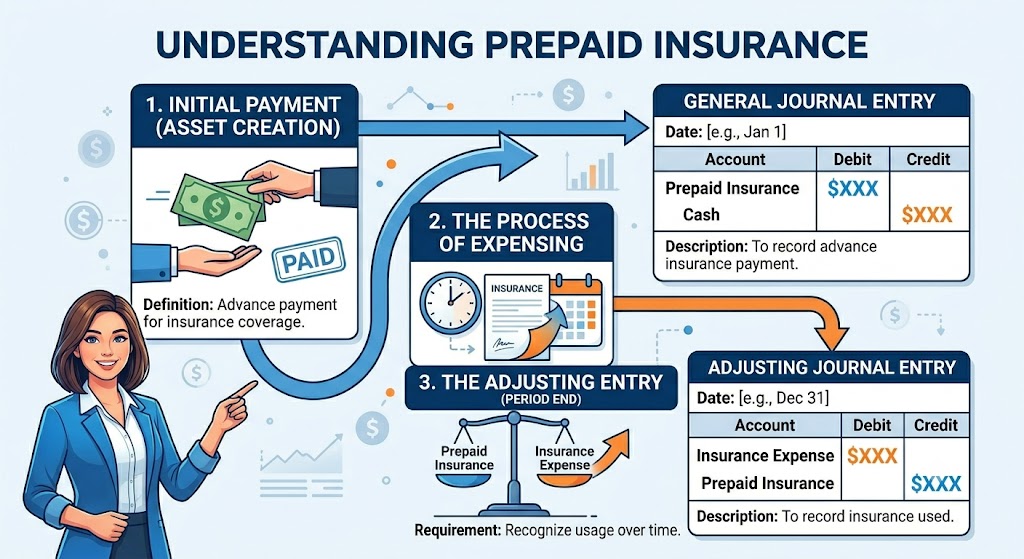
Recording prepaid insurance requires two separate journal entries:

  1. The initial entry when cash is paid
  2. The adjusting entry at the end of the accounting period

Let us go through both carefully.

Journal Entry 1: When Insurance is Paid

On the day the insurance premium is paid, the company records an asset, not an expense, because the coverage has not yet been consumed.

Format:

Dr. Prepaid Insurance       [full premium amount]
    Cr. Bank / Cash             [full premium amount]

This entry:

  • Increases Prepaid Insurance (a current asset) — debit
  • Decreases Bank (cash goes out) — credit

Example:

On 1 October 2024, a company pays $12,000 for a 12-month insurance policy covering 1 October 2024 to 30 September 2025.

Date: 1 October 2024

Dr. Prepaid Insurance       12,000
    Cr. Bank                    12,000

Narration: Payment of annual insurance premium for the period
           1 Oct 2024 to 30 Sep 2025

At this point, the balance sheet shows Prepaid Insurance = $12,000. No expense has been recognised yet.

Journal Entry 2: The Adjusting Entry at Period End

At the end of each accounting period, the company must calculate how much of the prepaid insurance has been used up and move that amount from the asset account to the expense account.

This is called an adjusting entry.

Format:

Dr. Insurance Expense       [expired amount]
    Cr. Prepaid Insurance       [expired amount]

This entry:

  • Recognises the insurance expense for the period — debit
  • Reduces the prepaid insurance asset — credit

How to calculate the expired amount:

  • Monthly insurance cost = Total Premium ÷ Total Months of Coverage
  • Expired amount = Monthly cost × Number of months expired in the period

Continuing the example:

The company’s accounting year ends 31 December 2024.

From 1 October 2024 to 31 December 2024 = 3 months of coverage have been consumed.

Monthly cost = $12,000 ÷ 12 months = $1,000 per month

Expired amount = $1,000 × 3 months = $3,000

Date: 31 December 2024

Dr. Insurance Expense       3,000
    Cr. Prepaid Insurance       3,000

Narration: Adjusting entry — insurance expired for Oct–Dec 2024
           (3 months × $1,000/month)

After this adjusting entry:

  • Insurance Expense on the Income Statement = $3,000
  • Prepaid Insurance on the Balance Sheet = $12,000 − $3,000 = $9,000

The $9,000 remaining on the balance sheet represents 9 months of future coverage (January to September 2025) — a genuine asset still to be consumed.

Complete Example: Tracking Prepaid Insurance Through the Full Year

Let us follow this policy all the way through to the end.

Facts:

  • Policy period: 1 October 2024 to 30 September 2025
  • Premium paid: $12,000 (all on 1 October 2024)
  • Company’s year-end: 31 December
  • Monthly insurance cost: $1,000

1 October 2024 — Initial Payment

Dr. Prepaid Insurance       12,000
    Cr. Bank                    12,000

Prepaid Insurance balance: $12,000
Insurance Expense to date: $0

31 December 2024 — First Adjusting Entry (Year 1 close)

3 months expired (Oct, Nov, Dec 2024)

Dr. Insurance Expense       3,000
    Cr. Prepaid Insurance       3,000

Prepaid Insurance balance: $9,000
Insurance Expense (Year 2024): $3,000

Balance sheet at 31 December 2024 shows Prepaid Insurance = $9,000
Income statement for 2024 shows Insurance Expense = $3,000

31 December 2025 — Second Adjusting Entry (Year 2 close)

9 months expired in 2025 (Jan to Sep 2025) — this consumes the remaining balance

Dr. Insurance Expense       9,000
    Cr. Prepaid Insurance       9,000

Prepaid Insurance balance: $0
Insurance Expense (Year 2025): $9,000

Balance sheet at 31 December 2025 shows Prepaid Insurance = $0
Income statement for 2025 shows Insurance Expense = $9,000

Total insurance expense over both years: $3,000 + $9,000 = $12,000

This equals the total premium paid confirming that the full $12,000 premium has been correctly allocated across the two accounting years in proportion to coverage received. The accrual basis has been properly applied.

The Ledger Account for Prepaid Insurance

Let us see how this looks in a T-account format:

Prepaid Insurance Account

          DEBIT                    |           CREDIT
-----------------------------------|-----------------------------------
1 Oct 2024  Bank       12,000      | 31 Dec 2024  Ins. Expense  3,000
                                   | 31 Dec 2025  Ins. Expense  9,000
                                   |
Total Debits:          12,000      | Total Credits:             12,000

The account opens, builds with the initial payment, reduces with each adjusting entry, and closes to zero when the full policy period expires. Clean and balanced.

The Alternative Method: Expense First, Then Adjust

Some companies follow an alternative approach especially smaller businesses or those using cash-basis bookkeeping who then adjust to accrual at year end. Instead of debiting prepaid insurance on the day of payment, they debit insurance expense directly.

Initial entry under alternative method:

Dr. Insurance Expense       12,000
    Cr. Bank                    12,000

Adjusting entry at 31 December 2024 (to reinstate the unused portion as an asset):

Unexpired portion = $1,000 × 9 months remaining = $9,000

Dr. Prepaid Insurance       9,000
    Cr. Insurance Expense       9,000

After this entry:

  • Insurance Expense (net) = $12,000 − $9,000 = $3,000
  • Prepaid Insurance on balance sheet = $9,000

The final result is identical to the first method. Both approaches are acceptable. The standard method (asset first) is cleaner and more commonly taught; the alternative method (expense first) is sometimes used in practice for routine, recurring payments.

Prepaid Insurance on the Income Statement

Prepaid insurance itself does not appear on the income statement. What appears is the insurance expense, the portion of the prepaid that has been used up in the period.

In our example:

  • Income statement for the year ended 31 December 2024 shows Insurance Expense: $3,000
  • Income statement for the year ended 31 December 2025 shows Insurance Expense: $9,000

The insurance expense reduces profit in each period. It appears under operating expenses typically within administrative expenses or general and administrative costs.

Prepaid Rent: The Same Concept Applied

Prepaid rent works in exactly the same way as prepaid insurance. If a company pays rent in advance for a future period, that advance payment is recorded as a prepaid asset and expensed as each month of the rental period passes.

Example:

On 1 December 2024, a company pays 6 months’ rent in advance at $5,000 per month — covering December 2024 to May 2025. Total payment = $30,000.

1 December 2024 — Initial Entry:

Dr. Prepaid Rent            30,000
    Cr. Bank                    30,000

31 December 2024 — Adjusting Entry:

1 month expired (December only)
Expired amount = $5,000

Dr. Rent Expense            5,000
    Cr. Prepaid Rent            5,000

Balance sheet at 31 December 2024:

  • Prepaid Rent = $30,000 − $5,000 = $25,000 (5 months remaining: Jan–May 2025)

Income statement for 2024:

  • Rent Expense = $5,000

The remaining $25,000 will be expensed at $5,000 per month from January to May 2025 through monthly adjusting entries.

Other Common Prepaid Expenses

Prepaid insurance and prepaid rent are the most common examples, but the same principle applies to many other expenses paid in advance:

Prepaid subscription costs — annual software licence fees (e.g., Microsoft 365, accounting software, cloud services) paid upfront. Each month, one-twelfth is expensed.

Prepaid advertising — a company books and pays for an advertising campaign in December for ads that will run from January to March next year. At the December year-end, the full amount is prepaid advertising (asset). It is expensed over the three months of the campaign.

Prepaid maintenance contracts — many equipment manufacturers sell annual maintenance contracts paid in advance. The prepaid portion is recognised as expense each month as the maintenance coverage is received.

Prepaid rates and taxes — business rates or municipal taxes sometimes paid at the start of the year for the full year. The portion relating to future periods is prepaid.

Prepaid insurance on loans (mortgage insurance) — sometimes insurance is built into loan repayments. The advance portion is prepaid.

The accounting treatment is identical for all of them:

  • Pay upfront → debit prepaid expense (asset)
  • As time passes → debit expense, credit prepaid (adjusting entry each period)

Prepaid Expenses vs Accrued Expenses: A Critical Distinction

These two are often confused because both relate to timing differences between cash payment and expense recognition.

FeaturePrepaid ExpenseAccrued Expense
What it meansPaid in cash before the expense is incurredExpense incurred but not yet paid in cash
Balance sheet positionCurrent assetCurrent liability
Cash flow timingCash paid first, expense recognised laterExpense recognised first, cash paid later
ExampleInsurance premium paid for next yearSalaries earned in December, paid in January
Journal entryDr. Prepaid Expense / Cr. Cash (initial)Dr. Expense / Cr. Accrued Liability
Adjusting entry directionAsset decreases, expense increasesLiability created, expense increases

A prepaid expense is an asset — you have something valuable in hand.
An accrued expense is a liability — you owe something.

Both arise because of the accrual basis of accounting, but they work in opposite directions.

The Matching Principle: The Theory Behind Prepaid Insurance

Everything we have discussed in this article is an application of the matching principle one of the most important concepts in accrual accounting.

The matching principle states that expenses should be recognised in the same accounting period as the revenue they help generate or, more broadly, in the period to which they relate.

Insurance expense relates to the period during which the insurance coverage protects the business. It does not relate to the period when the cheque is written. So we match the expense to its relevant period, regardless of when cash changes hands.

This is also the core principle behind:

  • Depreciation (spreading asset cost over its useful life)
  • Amortisation (spreading intangible asset cost over its useful life)
  • Deferred revenue (recognising revenue when earned, not when received)
  • Accrued income (recognising income when earned, even if not yet received)

The matching principle and accrual basis are required under both IFRS (IAS 1 and the Conceptual Framework) and US GAAP (FASB Concepts Statement No. 6). They form the foundation of modern financial reporting.

Prepaid Insurance in a Real Business Context

Let us look at a slightly more complex scenario that reflects real business life.

Scenario: Zenith Exports Ltd has a calendar year-end (31 December). On 1 April 2024, the company renews its comprehensive business insurance policy for $18,000 covering 1 April 2024 to 31 March 2025. The company also holds a vehicle insurance policy for a delivery truck $2,400 paid on 1 July 2024 covering 1 July 2024 to 30 June 2025.

Step 1: Initial Entries

1 April 2024 — Comprehensive policy:

Dr. Prepaid Insurance       18,000
    Cr. Bank                    18,000

1 July 2024 — Vehicle policy:

Dr. Prepaid Insurance       2,400
    Cr. Bank                    2,400

Step 2: Calculate Expired Amounts at 31 December 2024

Comprehensive policy:

  • Covers 1 April 2024 to 31 March 2025 (12 months total)
  • Months expired by 31 December 2024: April to December = 9 months
  • Monthly cost: $18,000 ÷ 12 = $1,500
  • Expired amount: $1,500 × 9 = $13,500
  • Remaining prepaid: $18,000 − $13,500 = $4,500 (Jan–Mar 2025)

Vehicle policy:

  • Covers 1 July 2024 to 30 June 2025 (12 months total)
  • Months expired by 31 December 2024: July to December = 6 months
  • Monthly cost: $2,400 ÷ 12 = $200
  • Expired amount: $200 × 6 = $1,200
  • Remaining prepaid: $2,400 − $1,200 = $1,200 (Jan–Jun 2025)

Step 3: Adjusting Entry at 31 December 2024

Date: 31 December 2024

Dr. Insurance Expense       14,700
    Cr. Prepaid Insurance       14,700

Narration: Insurance expired — comprehensive policy $13,500
           (9 months) + vehicle policy $1,200 (6 months)

Step 4: Balance Sheet and Income Statement Impact

Balance sheet at 31 December 2024:

  • Prepaid Insurance = $4,500 + $1,200 = $5,700

Income statement for year ended 31 December 2024:

  • Insurance Expense = $13,500 + $1,200 = $14,700

How to Handle Monthly Adjusting Entries

In the examples above, we made one adjusting entry at year end. But many companies especially those that produce monthly management accounts prefer to make adjusting entries every month.

Using our original $12,000 policy (monthly cost $1,000):

31 October 2024:
Dr. Insurance Expense       1,000
    Cr. Prepaid Insurance       1,000

30 November 2024:
Dr. Insurance Expense       1,000
    Cr. Prepaid Insurance       1,000

31 December 2024:
Dr. Insurance Expense       1,000
    Cr. Prepaid Insurance       1,000

Each month, $1,000 moves from the asset to the expense. By 31 December, the cumulative adjusting entries total $3,000 exactly the same as making one year-end entry. The frequency of adjustment does not change the result, only the timing of recognition within the year.

Monthly entries give more accurate monthly management accounts. Annual entries are simpler and still give correct annual figures. The choice depends on the company’s reporting needs.

Common Mistakes When Accounting for Prepaid Insurance

Mistake 1: Expensing the entire premium on the payment date

A company pays $24,000 for a 24-month policy and immediately debits Insurance Expense for $24,000. This overstates expense in the current period and understates it in future periods. Only the expired portion should be expensed each period.

Mistake 2: Forgetting to make the adjusting entry

This is very common. The initial entry is made correctly, but at year-end the adjusting entry is forgotten. Result: assets are overstated (prepaid insurance is still showing the full premium) and expenses are understated (no insurance expense is recognised for the year). Both the balance sheet and income statement are wrong.

Mistake 3: Calculating the expired period incorrectly

The calculation must be based on the coverage period, not the date of payment. If a policy covers 1 March to 28 February and payment is made in January for the upcoming period, the calculation starts from 1 March not from January.

Mistake 4: Treating prepaid insurance as a long-term asset

Most insurance policies are 12 months or less so the prepaid is a current asset. Only if a policy extends more than 12 months beyond the balance sheet date should the non-current portion be reclassified to long-term assets, which is rare in practice.

Mistake 5: Using the wrong account name

Prepaid insurance, prepaid expenses, and deferred insurance cost are all acceptable names. The key is consistency whichever name is used, it must be an asset account, not an expense account, at the time of payment.

Prepaid Insurance and Internal Controls

From an internal control perspective, prepaid insurance management involves several important controls:

Completeness: All insurance policies should be tracked on a prepaid insurance schedule a spreadsheet or module listing every policy, premium paid, coverage period, and monthly amortisation. Without this schedule, adjusting entries are based on guesswork.

Accuracy: Monthly amortisation amounts should be pre-calculated when the policy is set up and stored in the schedule, so adjusting entries are consistent and accurate.

Reconciliation: The prepaid insurance balance on the general ledger should be reconciled to the prepaid insurance schedule at every period end. Any difference signals an error.

Authorisation: Insurance policies should be renewed and paid only with proper management approval — insurance is a significant cost and the coverage chosen has financial risk implications.

Summary

  • Prepaid insurance is an insurance premium paid in advance for a future coverage period. It is a current asset on the balance sheet.
  • It arises because of the accrual basis and matching principle — expenses are recognised when incurred, not when paid.
  • When insurance is paid, the entry is: Debit Prepaid Insurance / Credit Bank.
  • At the end of each accounting period, an adjusting entry is made: Debit Insurance Expense / Credit Prepaid Insurance — for the portion of coverage expired in the period.
  • The prepaid insurance balance at any balance sheet date represents the unexpired future coverage still to be consumed.
  • Prepaid rent follows the exact same logic: debit prepaid rent when paid, adjust at period end for expired months.
  • Forgetting the adjusting entry is the most common mistake — it overstates assets and understates expenses.
  • A prepaid insurance schedule should be maintained to track all policies, their amortisation, and reconcile to the general ledger balance.

Frequently Asked Questions (FAQs)

Prepaid insurance is an asset with a normal debit balance. When insurance is paid, prepaid insurance is debited (increased). When the adjusting entry is made, prepaid insurance is credited (decreased) as it is converted to expense.


Prepaid insurance is a current asset account. It appears on the balance sheet, not the income statement. It becomes an income statement item (insurance expense) gradually through adjusting entries.


If an insurance policy is cancelled before it expires and a refund is received, the refund is credited to prepaid insurance (reducing it) and any remaining balance is reversed out. If the refund is less than the remaining prepaid balance, the difference is recognised as a loss on cancellation (expense). If the refund is more, the excess is a gain.


Yes — indirectly. Under the indirect method of preparing the cash flow statement, an increase in prepaid insurance during the year is deducted from net profit in the operating activities section (because cash went out but expense recognition was deferred). A decrease in prepaid insurance is added back.


This varies by jurisdiction. In many countries, for tax purposes, insurance premiums are deductible when paid (cash basis for tax) rather than when expired (accrual basis for accounting). This creates a temporary difference between accounting profit and taxable profit, which is a deferred tax item. In Bangladesh, consult the Income Tax Act 2023 and NBR guidelines for the specific treatment of insurance premiums as deductible business expenses.


Prepaid insurance is an asset, you paid in advance and still have future coverage coming. Insurance payable is a liability, you have received coverage but have not yet paid the premium (an accrued expense). They are opposite situations: prepaid is overpayment ahead of use; payable is underpayment behind use.

References

  1. International Accounting Standards Board (IASB). IAS 1 — Presentation of Financial Statements. Available at: ifrs.org
  2. International Accounting Standards Board (IASB). Conceptual Framework for Financial Reporting (2018). Available at: ifrs.org
  3. Financial Accounting Standards Board (FASB). SFAC No. 6 — Elements of Financial Statements. Available at: fasb.org
  4. Institute of Chartered Accountants of Bangladesh (ICAB). Bangladesh Financial Reporting Standards (BFRS) — Conceptual Framework. Available at: icab.org.bd
  5. Weygandt, J.J., Kimmel, P.D. and Kieso, D.E. Accounting Principles. 14th edition. Wiley, 2022. (Chapter on Adjusting the Accounts)
  6. Horngren, C.T., Harrison, W.T. and Oliver, M.S. Accounting. 10th edition. Pearson, 2020. (Accrual accounting and adjusting entries chapter)
  7. Warren, C.S., Reeve, J.M. and Duchac, J. Accounting. 27th edition. Cengage, 2020. (Chapter on the Adjusting Process)
  8. National Board of Revenue, Bangladesh. Income Tax Act 2023 — deductibility of business expenses. Available at: nbr.gov.bd

Leave a Comment

Your email address will not be published. Required fields are marked *